The 21st Century Barbaric Society: A Personal Ordeal of Injustice and Betrayal.
Chapter 1: The Dream of a New Beginning and a Deceptive Start
In 2021, my wife and I faced a pivotal moment, choosing to leave Brazil to escape its escalating violence and instability. Our vision was clear: to find a safe haven where we could build a stable future and raise a family free from fear. For me, the dream extended further—I longed to pursue a Master’s degree in acoustics engineering, inspired by Japan’s global leadership in the field’s innovative technologies.
Our path was fraught with challenges. My wife, hailing from humble roots, lacked English proficiency, formal certifications, and even a high school diploma, rendering it nearly impossible for her to secure a visa independently. My acceptance into a reputable foreign university became our only viable route to emigrate together, tying our family’s future to my academic success. We meticulously evaluated options across Europe and Asia, balancing program quality, cost, and livability. Ultimately, Canada stood out for its structured, merit-based immigration system and reputation as a welcoming nation for newcomers.
The University of Windsor, nestled in Canada’s southernmost city, emerged as our beacon. Its affordable graduate programs and milder climate—compared to Canada’s harsher northern regions—promised an easier transition from Brazil’s tropical warmth. Windsor’s proximity to the U.S. border and its industrial hub status also aligned with my interest in acoustics applications, particularly in engineering contexts like noise control.
Securing our place demanded relentless effort. Canada’s points-based immigration system, governed by Immigration, Refugees and Citizenship Canada (IRCC), required an exhaustive array of documents: certified translations of Brazilian records, proof of financial stability, and detailed evidence of my academic and professional qualifications to justify our entry into a nation that prized skilled contributions. Each submission felt like a high-stakes plea to prove our worth. After months of preparation, we triumphed. In January 2022, we arrived in Windsor, hearts brimming with hope, ready to embrace this hard-won opportunity. I was eager to launch my Acoustics Engineering program, envisioning it as the cornerstone of our new life.
That hope shattered upon registration. To my disbelief, the university had enrolled me in Industrial Engineering—a stark deviation from my clearly stated intent to study acoustics, as outlined in my application and supporting letters. This was no trivial oversight; it was a foundational error that threatened to unravel our carefully laid plans. What should have been a triumphant beginning morphed into confusion and dismay, hinting at the institutional negligence that would come to define our journey in this supposed land of opportunity.

Chapter 2: A Pattern of Escalating Hostility and Academic Sabotage
Refusing to let the university’s initial enrollment error derail my ambitions, I dedicated the next nine months to adapting and salvaging my academic path. I collaborated closely with a professor in the Industrial Engineering department, attempting to reorient my research toward Vibration Mechanics and Noise, Vibration, and Harshness (NVH)—a specialized subfield that could still connect to my acoustics background, provided the faculty endorsed this customized approach. This required significant adjustments, including rewriting research proposals and integrating my work into the department’s resources, where NVH often overlaps with practical applications in mechanical systems and human perception.
However, as I strove to regain stability, disturbing patterns began to surface. The professor overseeing my progress, affiliated with a lab focused on kinesiology-related applications, displayed increasingly erratic and unprofessional behavior. He repeatedly urged me to scrap my NVH topic in favor of alternatives that seemed to align more with his personal interests than my goals. Even more troubling, he overstepped professional boundaries by making requests far beyond academic supervision: he solicited detailed schematics for his private, non-university projects and, in a blatant violation of etiquette, used his official university email to demand access to my personal LinkedIn account for his own use. These intrusions felt not just inappropriate but exploitative, eroding the trust essential to a mentor-student relationship.
The situation escalated into overt hostility in June 2022 during a required seminar class. A different professor publicly shamed me for arriving only four minutes late, branding me a “liar” in front of my classmates and issuing a ominous declaration that he would now take a “personal deal” in managing my academic affairs. This confrontation hit particularly hard, coming right after I had paid roughly $16,000 CAD for my second-term tuition, heightening my sense of being financially locked into a toxic environment.
A momentary spark of progress emerged in September 2022 when I convinced my lab supervisor to invest in essential equipment for my NVH studies, including tools for vibration analysis and simulation. For the first time in months, it seemed possible to push forward and aim for graduation by the end of 2023, allowing my family to finally exhale.
That fragile momentum was obliterated just a month later. In October, my supervisor suddenly backtracked, insisting on yet another topic change. When I confronted him about the newly acquired equipment and the extensive drawings and preparations I had already completed, his reply was a stark display of unchecked authority: “The laboratory is mine, the funds are mine, and I do as I please.” This dismissal not only wasted resources but also underscored a deeper issue of power imbalance in the academic hierarchy.
Left with no viable alternative, I formally requested a supervisor reassignment through the university’s graduate office. The outcome was disheartening: my only available option was the very seminar professor who had already demonstrated personal animosity toward me. It felt premeditated, like a deliberate funneling into further adversity, transforming what should have been scholarly pursuit into a grueling fight against systemic sabotage and bias.

Chapter 3: From Obstruction to Open Warfare: The Falsification Charge
Cornered under a supervisor harboring evident resentment, I held onto a perhaps overly optimistic belief: that by strictly adhering to university protocols and producing impeccable work, my dedication would prove irrefutable. To bypass the deliberate roadblocks—email responses delayed by weeks and lab equipment that arrived faulty, necessitating even longer fixes—I relocated my entire research operation to my home. Using my own scarce resources, I purchased critical tools: a 3D printer for building prototypes, advanced measurement devices for data collection, and budget-friendly transducers for validation testing. My thesis relied heavily on computational simulations, and fortunately, my personal computer outperformed the outdated lab machines, allowing me to maintain productivity without institutional support.
This self-reliance came amid mounting personal pressures that tested my limits. In March 2023, I confided in my supervisor about my wife’s pregnancy, hoping it might evoke some empathy given her ongoing unemployment and our tightening finances. Relief came partially in July when she landed a housekeeping role at ServiceMaster, a company linked to the university through affiliations. Our son was born in November 2023, a moment of pure elation overshadowed by the relentless demands of newborn care—sleepless nights compounded by my solitary research efforts and full-time work. I shared this milestone with my supervisor, underscoring the isolation of my academic journey, but my plea for understanding went unacknowledged.
Defying the odds and operating with virtually no guidance, I forged ahead. My preliminary thesis defense in late October 2023 marked a hard-fought milestone: despite improvising experiments in my backyard due to deficient laboratory, the panel deemed my work viable, granting a “pass with major corrections.” This standard outcome required targeted revisions but validated the substance of my research, offering a glimmer of closure.
As I dove into those amendments, my supervisor executed his most egregious maneuver. In May 2024, he submitted a groundless complaint to the university senate, charging me with data falsification—without a shred of evidence or any prior attempt at collaborative resolution. I was utterly astounded; this accusation flouted fundamental academic norms, where supervisors are duty-bound to oversee and rectify data issues through iterative guidance, as outlined in institutional integrity policies. Instead, it appeared as a calculated strike, potentially self-incriminating given his oversight role, yet aimed squarely at tarnishing my reputation and halting my progress.
The university, rather than scrutinizing the claim or my supervisor’s pattern of conduct, weaponized it to prolong my limbo, extracting an additional $8,000 CAD in tuition fees every four months under the guise of ongoing enrollment. Strapped for cash and navigating a foreign legal landscape, I sought aid from Community Legal Aid (CLA), a pro bono service for low-income individuals. What I encountered was not impartial counsel but inherent bias: the CLA operated with university law students under faculty supervision, creating a clear conflict. Their recommendation? To plead guilty—a preposterous suggestion given my innocence.
I stood firm against this coercion, asserting that my sole “transgression” was the earlier seminar dispute with my supervisor. Cornered by the system and my ostensibly supportive advisors, I was maneuvered into a reluctant compromise: drafting an apology letter that conceded only an “honest mistake” in execution, while explicitly rejecting any label of academic misconduct. Bolstered by this partial vindication, I countered through formal channels, submitting a Form-32 complaint for misconduct against my supervisor and an ombudsman appeal alleging personal reprisal. In a pattern of institutional deflection, both were dismissed outright by the senate, devoid of any investigation or rationale.

Chapter 4: The Final Collapse
By May 2024, I had painstakingly completed all required thesis corrections, pouring every ounce of effort into meeting the university’s demands. Yet, the administration stonewalled my attempts to schedule a second defense, trapping me in an academic purgatory. As the Fall term approached, I reached a breaking point. I informed the dean’s secretary that I would not re-enroll or pay another dime for services the university had failed to deliver—approximately $8,000 CAD every four months. I stated bluntly that I’d rather invest in legal representation than continue funding this farce. The university’s response was a barrage of pressure, but by late August, a shift occurred: administrative officials intervened, urging me to enroll for the Winter term with assurances that I could finally complete my program.
Clinging to this promise, I acted in good faith. In July 2024, anticipating further obstruction, I had filed a Freedom of Information and Protection of Privacy Act (FIPPA) request to secure my complete academic records, sensing they would be critical for any future disputes. I paid a reduced tuition fee of $4,000 CAD for the Winter term, resubmitted my meticulously revised thesis, and relentlessly pressed the dean’s secretary for the promised defense date. Each inquiry was met with vague assurances, but no action followed.
Instead of resolution, a devastating sequence unfolded, dismantling my life with ruthless precision. In early November 2024, just five days before my wife’s parental leave was set to end, I was abruptly fired from my job without cause. The connection was chillingly clear: the company owner, a professor at the university, was a close associate of my supervisor, suggesting a coordinated act of retaliation.
January 2025 brought a merciless cascade of blows over four catastrophic days:
January 7th: Driven to the edge, I took a stand, filing a police report against my supervisor for fraud, determined to hold him accountable for his role in my academic sabotage.
January 9th: The university struck a fatal blow to my academic aspirations. I received notice that I had failed for “inadequate thesis revisions,” denying me the second defense I was explicitly promised. By January 30, they escalated, issuing a letter demanding my withdrawal from the program, citing “performance issues” as a flimsy pretext.
January 11th: My personal life imploded. My wife filed a baseless domestic violence claim, accusing me of kicking and punching her. Her sole “evidence” was a bruise on her buttock, which I knew stemmed from her accidental fall over a chair the previous day. No other substantiation existed.
January 12th: Without any meaningful police investigation, I was arrested based solely on her allegation. Released hours later under a restraining order, I was barred from my home and contact with my family, including my infant son.
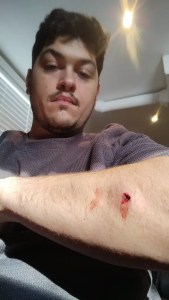
In just 96 hours, I was stripped of my academic standing, livelihood, and family. Homeless, jobless, and financially drained in the depths of a Canadian winter, I spent one night shivering in my car at −14°C, followed by two nights in a budget hotel, scraping together my last resources. On January 15, 2025, broken and bereft, I boarded a flight back to Brazil, forced to leave my newborn son behind in a country that had betrayed every hope I had brought to its shores.


Chapter 5: A War on All Fronts, Fought from a World Away
Exiled in Brazil, my forced departure from Canada marked not the end of my struggle but the beginning of a relentless, multi-front campaign against the interlocking systems that shattered my life. From thousands of miles away, I launched legal and administrative battles, each met with institutional resistance designed to protect the powerful and silence the vulnerable. My resolve, however, remains unbroken, fueled by the urgent need to reunite with my son and expose the injustices I endured.
The Fight for My Son: My most pressing battle is for my infant son, Isaac, left in Canada with his mother—a non-English speaker with no formal qualifications, whose dependent visa expired alongside mine on January 30, 2025, per Canada’s immigration regulations tying her status to my student visa. I firmly believe she was coerced into her actions, manipulated by university affiliates into a role that sustains their agenda. Through Ontario’s Superior Court, I filed for custody, emphasizing the precariousness of her situation and the risks to our son’s well-being in an environment of such calculated hostility. Pursuing this from Brazil has been a logistical nightmare; after more than five attempts to secure substitute service to reduce prohibitive costs, I obtained a judicial order in late April 2025, only for it to be inexplicably revoked a week later without clear justification, leaving my case stranded in procedural limbo.
The Fight Against the University: I challenged the university’s decision to fail me through a Form-55 appeal, requesting reevaluation by an independent committee. This was swiftly overruled, followed by a vague, dismissive decision letter in March 2025. My pursuit of transparency through Freedom of Information and Protection of Privacy Act (FIPPA) requests met similar resistance: initial submissions were rejected on the specious claim they pertained to another individual’s records. An appeal to the Information and Privacy Commissioner of Ontario (IPC) languished for over 100 days before being denied without explanation. In June 2025, I refiled FIPPA requests directly with the university’s Director of Legal Affairs, simultaneously challenging the legality of prior rejections, citing procedural impartiality requirements under Ontario’s FIPPA legislation.
The Fight for My Name: In my criminal case, stemming from my wife’s false domestic violence claim, I’ve faced systemic obstruction in accessing justice. In April 2025, I requested a pretrial hearing, demanding an independent medical pathologist’s review of the police photos of my wife’s bruise—the sole piece of evidence against me. Authorities refused disclosure, claiming the images were “police property” and that I might “misuse” them. This secrecy is suspect, especially given my wife’s brief admission of shame over those photos post-arrest, suggesting potential inconsistencies or manipulation in their presentation. My right to scrutinize the evidence against me, as a fundamental principle of Canadian law, is being denied.
The Fight Against the System: As each institution shielded the others, I broadened my challenge to confront systemic collusion:
Human Rights Tribunal of Ontario (HRTO) Applications: I filed two—one against the university for discrimination and reprisal, and another against the Windsor police for collusion and discriminatory handling of my case, evidenced by their refusal to investigate my complaints.
Police Reports: In February 2025, I filed a second fraud report against my supervisor, building on the January filing. In July 2025, I lodged a mischief and obstruction of justice claim against the university’s Legal Director for deliberately delaying my FIPPA request by 60 days, violating procedural timelines on the final allowable day. Police dismissed these as “civil matters,” a deflection I view as further evidence of bias.
Oversight Complaints: I submitted grievances to the Law Enforcement Complaints Agency (LECA), the Office of the Independent Police Review Director (OIPRD, or its successor), and other oversight bodies like the Ontario Provincial Police (OPP), Royal Canadian Mounted Police (RCMP), and Canada Border Services Agency (CBSA). Each was ignored or dismissed without investigation, reinforcing a pattern of institutional self-preservation. This relentless wall of resistance underscores a chilling truth: the system is engineered to protect itself, prioritizing power over accountability. Yet, I continue to fight, driven by the need to reclaim my son and expose the mechanisms that exploit the vulnerable.

Chapter 6: A War on Two Fronts: Public Harassment and Institutional Complicity
As my legal battles against the university and for my son’s custody intensified, the retaliation against me evolved into a dual-pronged assault: a public campaign of harassment aimed at destroying my professional reputation and a deeper institutional conspiracy exploiting my family’s vulnerability. These tactics, blending overt aggression with covert manipulation, revealed a system determined to silence dissent through intimidation and control.
Reprisal in the Public Square
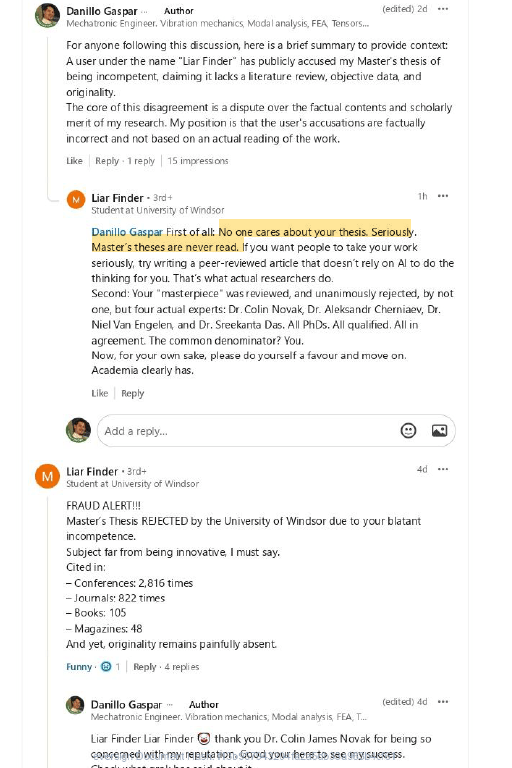
Barred from a final thesis defense and stonewalled by university bureaucracy, I turned to LinkedIn to share my work, “Energy Harvesting for Slender Active Civil Foundations,” seeking feedback from the global academic community and a chance to salvage my scholarly identity. Almost immediately, a newly created account under the pseudonym “Liar Finder,” identifying as a “Student at University of Windsor,” launched a vicious campaign in the comments section. The account posted inflammatory accusations like “FRAUD ALERT!!!” and claimed my thesis was rejected for “blatant incompetence,” echoing the exact language of “liar” used by my supervisor during the June 2022 seminar incident—a public humiliation that had marked the start of his vendetta.
The harassment escalated with a comment exposing privileged, non-public information:
“Your ‘masterpiece’ was reviewed, and unanimously rejected, by not one, but four actual experts: Dr. Colin Novak, Dr. Aleksandr Cherniaev, Dr. Niel Van Engelen, and Dr. Sreekanta Das. All PhDs. All qualified. All in agreement. The common denominator? You.”
The full composition of my thesis review committee was not publicly disclosed, making this revelation a clear signal of insider involvement—likely my supervisor, Dr. Colin Novak, or an ally acting on his behalf. I view this online assault as direct retaliation for my Human Rights Tribunal of Ontario (HRTO) filing against the university, intended to discredit me and deter further action. The campaign culminated in a chilling directive: “Now, for your own sake, please do yourself a favour and move on.” Given the power imbalance and history of hostility, this was not advice but a thinly veiled threat, designed to intimidate me into silence.
An Unholy Alliance
Simultaneously, a more insidious form of institutional complicity emerged, weaponizing my family against me. My wife’s legal status in Canada, tied to my student visa as a dependent, expired on January 30, 2025, per Immigration, Refugees and Citizenship Canada (IRCC) regulations. A June 19, 2025, court endorsement by Justice J. Kalajdzic confirmed her immigration status as “in flux” and noted her rejected application for a Temporary Resident Permit (TRP), indicating she lacks valid work authorization. Yet, she continues to be employed as a housekeeper by university-affiliated services, a glaring violation of Canada’s Immigration and Refugee Protection Act, which prohibits hiring individuals without legal status.
This institutional “lenience” is not mere oversight; it feels like a deliberate strategy to sustain her presence in Canada, enabling the ongoing alienation of my son, Isaac. I believe my wife, vulnerable due to her limited English and lack of resources, has been coerced by university affiliates into serving as a proxy in their campaign against me. By facilitating her employment, the university ensures her financial stability, binding her to a system that holds our son hostage while obstructing my custody efforts. This calculated manipulation transforms my family’s fragility into a tool of retaliation, ensuring I remain cut off from Isaac while the university evades accountability.
Together, these fronts—public defamation and institutional exploitation—expose a chilling undercurrent: an academic institution wielding its influence to orchestrate a campaign of harassment and control, using proxies to shield itself from scrutiny. My fight for justice, for my son, and for truth presses on against this formidable alliance.
Chapter 7: A Son Held Hostage, A Call for Justice
My journey to Canada began with a fervent dream: to forge a secure future for my family in a land celebrated for opportunity and fairness. Instead, it spiraled into a nightmare of betrayal, orchestrated by the very institution tasked with nurturing my aspirations. Exiled in Brazil, I endure the agony of separation from my infant son, Isaac, trapped in Canada for over 190 days. The University of Windsor, a publicly funded entity, did not merely fail me academically; it engineered the systematic destruction of my life, exploiting my family’s vulnerability to silence my pursuit of justice.
I allege that the university’s complicity extends to enabling my wife’s continued presence in Canada, despite her expired visa, through employment with affiliated services—a flagrant violation of Canada’s Immigration and Refugee Protection Act. This calculated “lenience” sustains her financially, perpetuating the wrongful retention of my son while thwarting my custody efforts through Ontario’s Superior Court. Isaac, an innocent child, is effectively held hostage by a web of institutional malfeasance, robbed of his father’s embrace and the warmth of his grandparents and cousins in Brazil, who yearn for his return.
This ordeal exposes a barbaric underbelly in 21st-century academia: a system where unchecked power preys on international students, exploiting their isolation and limited resources. The university’s tactics—public defamation through proxies like the “Liar Finder” account, baseless academic accusations, and manipulation of my wife’s precarious status—echo the ruthless strategies of organized malfeasance, where the powerful shield themselves behind vulnerable pawns.
Yet, I will not be silenced. My fight transcends personal redemption; it is a crusade for my son’s safety, for the restoration of my honor, and for every international student ensnared by such exploitation. Through relentless legal battles—HRTO applications, police reports, FIPPA requests, and custody petitions—I demand accountability for the professors and administrators who orchestrated this nightmare. I call on authorities, media, and the public to dismantle the mechanisms that transform educational institutions into instruments of oppression.
Above all, I fight for Isaac, whose right to his father’s love and protection must not be sacrificed to institutional vendettas. I demand systemic reform to shield future students from such horrors, ensuring that no other family’s Canadian dream becomes a 21st-century tragedy. My story is a clarion call for justice, a plea to halt the unchecked criminality that festers when power goes unquestioned—it resembles the era when men dragged women by their hair, a primitive barbaric savagery repackaged in the guise of modern academia.

Chapter 8: The Silent Victims – When Dreams Lead to Despair
As I reflect on my own nightmare at the University of Windsor—where academic sabotage, false accusations, and institutional collusion shattered my family—I realize my story is just one thread in a vast web of exploitation. Within the same university walls, and across Canada, even more vulnerable students face horrors that end in silence and tragedy. These are the forgotten ones: impoverished young people from developing nations, whose families scrape together life savings—often pooling resources from three or four households—to send them abroad for a “better future.” They arrive with limited education, no networks, and dreams fueled by glossy promises of Canadian opportunity. Instead, they encounter exclusion, predatory professors, and a system rigged against them.
Imagine a student from a rural village in India or Africa, where entire communities mortgage homes or sell land to fund the journey.
They enroll in low-quality programs at “diploma mills”—colleges that masquerade as gateways to prosperity but deliver subpar education and exploitation. Facing language barriers, cultural isolation, and “bad professionals” who fail them arbitrarily—perhaps due to bias, over-enrollment pressures, or outright neglect—these students plummet into despair. Mandated to leave after visa expiration or academic dismissal, they confront unimaginable shame: returning home empty-handed, burdened by debts that could ruin generations. For some, the weight is too much. Whispers in university dorms tell of suicides—students ending their lives on campus, driven by financial ruin, family dishonor, and the crushing realization that their “Canadian dream” was a scam. Reports confirm this grim reality: At least 47 international students, many Punjabi, died by suicide in 2023 alone due to financial stress and exploitation, with temples and community leaders stepping in where universities failed. Yet, these deaths are often occluded from public scrutiny—universities don’t track or report them systematically, burying the truth to protect their reputations and the billions in tuition revenue from international students. It’s a barbaric cycle: Lure the desperate with false promises, exploit their labor and fees, then discard them when they break. Criminal organizations cannot disguise themselves as academia to attract good, family-oriented, highly educated people—only to scam them at what should be society’s highest level. These institutions, meant to elevate humanity, instead become traps for the vulnerable, turning dreams into despair. Why target families and the less educated? Because their shame and debt make them silent victims, less likely to speak out.
For these poorer students, the violation is even more profound, ending in unmarked graves and hushed obituaries.
This must be prostrated—exposed and protested—for the world to see. I call on survivors, communities, and authorities to demand transparency: Mandatory suicide tracking in universities, crackdowns on exploitative colleges, and protections for international students from debt bondage and mental health crises.
Only then can we prevent more families from gathering their last coins for a ticket to tragedy.

Chapter 9: Facades of Legitimacy – Comparing University Exploitation to Brazil’s Favelas
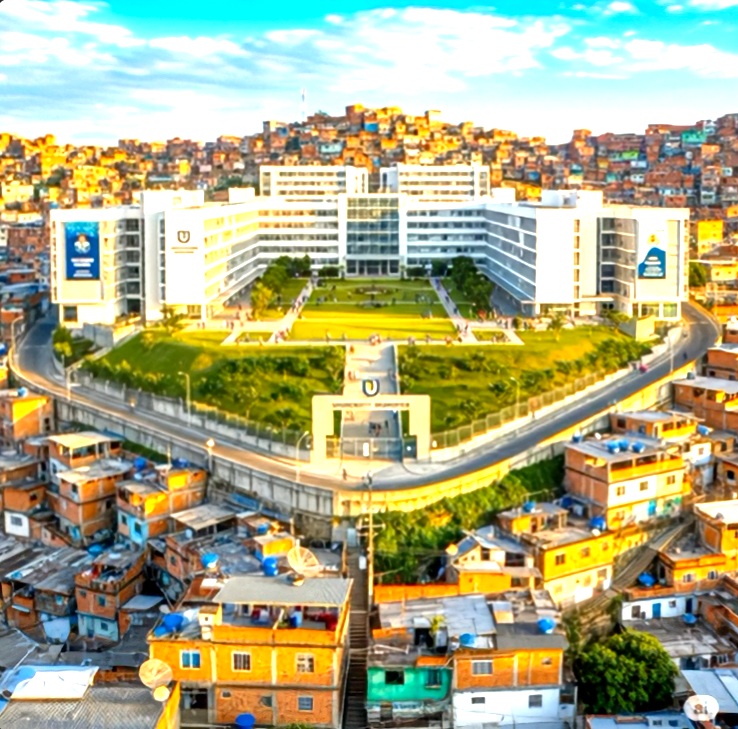
As I unravel the layers of betrayal in my own story—from academic sabotage at the University of Windsor to the institutional complicity that alienated my son—I’ve come to see parallels with the lawless favelas of Brazil, the slums where I once sought to escape. In those forgotten neighborhoods of Rio de Janeiro and São Paulo, criminal organizations rule openly, turning communities into fortresses of fear where drug gangs impose their own brutal order.
These are lawless lands, devoid of state oversight, where traffickers and cartels conduct their “business” in plain sight—extorting residents, peddling drugs, and enforcing silence through violence.
Everyone knows the dangers; the criminals don’t bother disguising themselves as pillars of society. They thrive in the shadows of poverty, preying on the desperate without pretense.
Yet, as horrific as the favelas are, there’s a raw honesty to their criminality—they don’t lure victims with glossy advertisements or false promises of enlightenment.
This stands in stark contrast to the hollow promise of higher learning I found at the University of Windsor. People enroll in a graduate program with a clear and noble desire: to achieve a higher level of education and enhance themselves professionally and technically. They seek to learn from experts and contribute to their field. But what I learned at Windsor had more in common with the survival tactics of the favelas than with genuine academic growth. The environment was fundamentally unethical and un-academic, populated by lazy, self-centered professors masquerading as scientists.
Contrast this with the “criminal organizations disguised as universities” in Canada, where exploitation hides behind the veneer of academia. These institutions—often “diploma mills” posing as legitimate colleges—post alluring promotions on global networks, touting themselves as gateways to prosperity and recognized credentials. They attract educated families like mine, or even the most vulnerable from abroad, only to ensnare them in webs of fraud, debt, and human trafficking.
The professional negligence was staggering. I witnessed professors pretend they didn’t have a classroom key simply to adjourn class out of laziness. The lack of basic knowledge was even more shocking. In one instance, my supervisor, Dr. Novak, incorrectly insisted that the decibel (dB) was a dimensionless unit in all contexts. I had to correct him, explaining that while it may be treated as such in electronics, in acoustics it represents a physical intensity of Watts per square meter (W/m²). The fact that I, the student, was teaching a professor a fundamental concept in his own department was a clear sign that the educational mission was a farce. Instead of mentorship, I found a culture of coercion and unprofessionalism. The most significant research produced by these so-called scientists during my time there was a rubber band for a phone cover https://scholar.uwindsor.ca/etd/9378/ https://www.uwindsor.ca/graduate-studies/2369/final-oral-defense-%E2%80%8Broopak-sri-venkata-sai-madhavarapu-masc a triviality that speaks volumes about the institution’s intellectual bankruptcy.
Yet, as horrific as the favelas are, there’s a raw honesty to their criminality—they don’t lure victims with glossy advertisements or false promises of enlightenment. Contrast this with the “criminal organizations disguised as universities” in Canada, where exploitation hides behind the veneer of academia.
These institutions—often “diploma mills” posing as legitimate colleges—post alluring promotions on global networks, touting themselves as gateways to prosperity and recognized credentials. They attract educated families like mine, or even the most vulnerable from abroad, only to ensnare them in webs of fraud, debt, and human trafficking. In the favelas, the lawlessness is overt—gangs control territories, and police “pacification” operations occasionally reclaim them, exposing the rot for all to see. But in these sham universities, the occlusion is greater: Failures, suicides, and exploitation are buried under layers of bureaucracy and denial. Investigations reveal over 260 Canadian colleges linked to trafficking schemes, where fake admissions funnel students into illegal migration, debt bondage, or worse—yet these entities advertise as “well-recognized” without immediate repercussions.
In the favelas, the lawlessness is overt—gangs control territories, and police “pacification” operations occasionally reclaim them, exposing the rot for all to see. But in these sham universities, the occlusion is greater: Failures, suicides, and exploitation are buried under layers of bureaucracy and denial. Investigations reveal over 260 Canadian colleges linked to trafficking schemes, where fake admissions funnel students into illegal migration, debt bondage, or worse—yet these entities advertise as “well-recognized” without immediate repercussions. The facade allows them to operate in “lawless” pockets within a supposedly regulated society, making the deception even more barbaric than the open brutality of Brazil’s slums.
This comparison haunts me: In favelas, criminals don’t pretend to be saviors; they rule through fear alone. Universities, however, cloak their “business”—exploiting international students for billions in tuition while discarding the broken—behind degrees and diplomas. The result? Greater occlusion, as scandals are hushed, and victims like me—or the impoverished students who end their lives in despair—are erased from public view. We must tear down these disguises, demanding oversight that pierces the academic veil and exposes the criminals within. Only then can we prevent more families from being lured into this 21st-century savagery.
Chapter 10: The Illusion of Preference – Family Vulnerabilities, Exploitation, and Institutional Collusion
In piecing together the fragments of my shattered Canadian dream, I’ve grappled with the immigration system’s deceptive allure—how it dangles family reunification as a beacon of hope, only to expose us to predators lurking within academia’s halls. Canada’s policies don’t overtly “prefer” married applicants over singles in a discriminatory sense; they’re crafted to be merit-based and family-centric, fostering long-term integration and economic growth.
But this very design creates cracks that scammers and exploiters widen into chasms, turning educated families like mine into prime targets.
At its core, family reunification is a cornerstone of Canadian immigration law, rooted in humanitarian ideals since the 1970s.
Spouses, partners, and children can join the principal applicant—whether a student like me or a skilled worker—through dependent visas or sponsorship programs. In Express Entry, the economic immigration stream, a spouse’s skills, education, or language proficiency can add valuable points, but this isn’t a bias toward marriage; it’s about enhancing the family’s overall contribution to society. Singles face no penalties—they simply don’t receive those bonus points. The process remains rigorous for all: Fraud checks demand proof of genuine relationships, like marriage certificates, shared finances, and even interviews to weed out “marriages of convenience.”
Spousal sponsorships require the sponsor to demonstrate financial support for three years, with processing delays stretching 12 months or more. It’s gender-neutral, encompassing common-law and conjugal partners, debunking any notion of a targeted “interest in women.”
Yet, this family-oriented framework can feel like a trap. Canada promotes stable immigrants who root themselves through familial bonds, reducing turnover and bolstering communities.
For married students like me, my wife’s dependent visa was inextricably linked to mine, creating a chain of vulnerability: If I faltered—through sabotage or expulsion—she did too, unless manipulated into independent status via claims of abuse or other loopholes. This isn’t a sinister “preference” but a flaw that bad actors exploit, luring families with “pathways” that devolve into debt, isolation, and coercion.
The dark underbelly emerges in how these vulnerabilities intersect with academia’s exploitation machine. International students and their families become fodder for “diploma mills”—bogus or substandard colleges that promise education and visas but deliver financial ruin or worse. Over 25,000 Indian students alone have fallen victim to trafficking, where agents extract exorbitant fees for fake admissions, trapping migrants in debt bondage, forced labor, or sex work. Families are prime prey because dependents add leverage: Exploiters use isolation, language gaps, and visa fears to coerce silence, with women comprising 96% of trafficking victims in Canada. Marriage fraud thrives here, with faked unions paving the way for independent stays via abuse claims, echoing protections meant to help but twisted against sponsors like me. Educated, family-bound immigrants are “ideal” victims: Our investment in ego, money, and loved ones makes us endure longer, yielding more profit for the exploiters. As the adage goes, never mess with another man’s family, ego, or money—they did all three to me, precisely because it ensures compliance through shame.
This exploitation doesn’t operate in isolation; it often involves insidious collusion with police and local city authorities, turning supposed sanctuaries into echo chambers of impunity. In cities like Windsor, where the university is a economic lifeline—drawing international tuition dollars that prop up local businesses—the incentive to overlook abuses is stark.
Reports highlight patterns where campus security and local police collaborate closely, sometimes mishandling complaints from marginalized students, including international ones facing racism or exploitation. In my case, police dismissed my fraud reports against university figures as “civil matters,” refused to investigate my wife’s potentially coerced domestic violence claim, and even withheld evidence like photos—actions that felt like protectionism for the institution. Broader scandals reveal similar ties: Universities like Windsor have faced accusations of downplaying hate crimes or excessive police force against students of color, with investigations stalling amid close campus-police partnerships. The city benefits economically from the student influx, potentially turning a blind eye to exploitations that keep the revenue flowing.
This collusion—whether overt or through inaction—amplifies the barbarism, allowing “criminal organizations disguised as academia” to flourish unchecked.
Governments are responding with measures like visa caps and college audits, but true change demands exposure. My ordeal, like those of countless others, underscores that the “preference” for families is no benevolence—it’s a gateway to vulnerability, where scammers thrive under institutional shields. We must dismantle these facades, holding universities, police, and cities accountable, lest more dreams dissolve into despair.
After a life investment of more than half a million dollars in education to build a future, the outcome is a twisted inversion of the Canadian dream. Canada has decided to keep my wife, a cleaner with no formal education even in her mother tongue, and my son, a child now forced into a broken family to be raised without a father. One must ask what kind of society they believe they are building. Is this the outcome they would desire for their own families? Because actions have reactions, and if this is the standard they set, they risk establishing a horrific new tradition where the price of travelling abroad is having your children ripped away from you.

DISCLAIMER : The content on this website, including all posts, chapters, and materials, represents the personal experiences, opinions, and views of the author, Danillo Galdo Gaspar, based on events as I perceive them. It is provided for informational and advocacy purposes only and is not intended to be, nor should it be construed as, legal advice, professional counsel, or a definitive statement of fact.
Any allegations of misconduct, discrimination, collusion, or other issues mentioned herein are alleged and have not been adjudicated in a court of law unless explicitly stated otherwise. Readers are encouraged to conduct their own independent research, verify information through official sources, and consult qualified professionals (such as lawyers or authorities) before forming conclusions or taking action.
This site exercises rights to freedom of expression under the Canadian Charter of Rights and Freedoms and aims to raise awareness about potential systemic issues in higher education and immigration. No malice is intended toward any individuals or institutions named, and the author welcomes factual corrections or dialogue to promote accuracy and resolution.
The author disclaims any liability for errors, omissions, or consequences arising from the use of this content. By accessing this site, you agree to these terms and acknowledge that the information is shared in good faith for public interest discussion.
Last updated: July 25, 2025
 Stop University of Windsor