I affirm my unwavering adherence to all laws governing human conduct.
I was duly invited to Canada through legitimate channels and never remained on Canadian soil illegally for even a single day.
Throughout my time there, I fulfilled all financial obligations, covering expenses diligently, and demonstrated profound love and commitment to my family at every opportunity, even as they chose to remain behind.
In reflecting upon the principles that should guide civilized society, I invoke the words of,
Peter Kropotkin:
“Competition is the law of the jungle, but cooperation is the law of civilization.”
Email request for ill use of personal account
Direct email with unethical, unacademic and unprofessional misconduct by 1st supervisor. Request to use personal account for personal use and spend my free trial for his affairs.
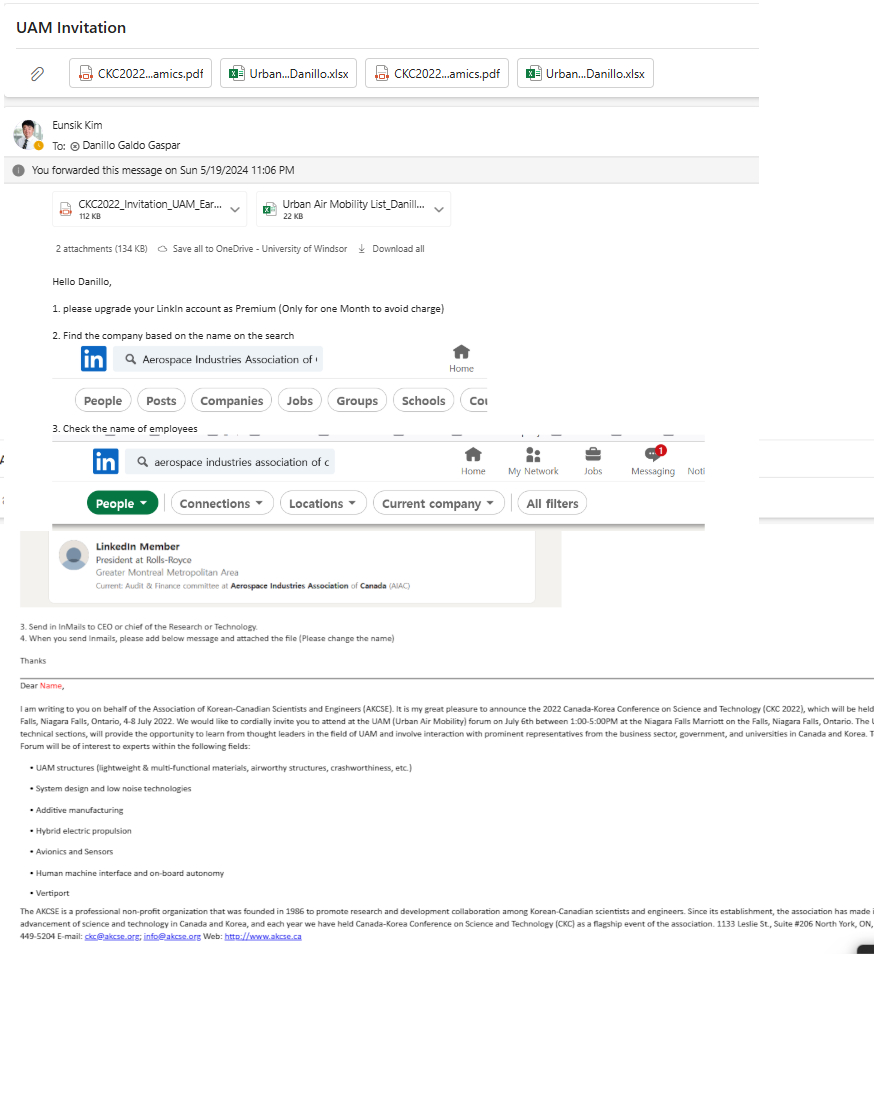
I am deeply troubled by an unprofessional and unethical request from my 1st supervisor. Attached is an email where they instructed me to:
- Upgrade my personal LinkedIn account to Premium (using my free trial to avoid charges).
- Conduct research on their behalf, including identifying and contacting high-profile professionals (e.g., CEOs, industry leaders) via LinkedIn InMail.
- Send invitations to an event under my name while attaching their files.
This request crosses clear ethical boundaries:
- Misuse of personal accounts for professional gain.
- Exploitation of free trials to avoid institutional costs.
- Misrepresentation (asking me to pose as the sender of official invitations).
Academic supervisors should uphold integrity, not compromise it. Has anyone faced similar demands? How would you address this?
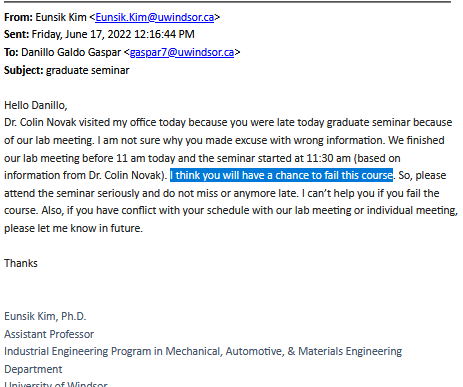
I would have a chance to fail to program threat
Threatened after 6 months into program, just paid the second term about CAD$16000/24000/year. For a 4 minutes lateness washroom stop. Retaliating against me from above email questioning.
I was 4 minutes late to a graduate seminar due to a washroom stop.
My supervisor falsely claimed I gave “wrong information” as an excuse, despite our lab meeting ending well before the seminar.
Threatened me with failing the course, despite no prior warnings or policy violations.
Financial & Academic Stress:
- I am an international student paying $24,000/year in tuition.
- This threat came just after I paid $16,000 for my second term.
Pattern of Unprofessional Behavior:
Now, they are using minor lateness as grounds for academic retaliation.
Previously, my supervisor demanded I misuse my personal LinkedIn account for their professional gain (see attached email).
No email reply or perfunctory addressing
More than 20 emails never replied and much more with perfunctory of mocking replies.
Breach of supervisory duty – Advisors are obligated to provide timely feedback.
Wasted time & resources – Delays due to unresponsiveness cost me months of work.
Academic sabotage – Ignoring thesis-related emails risks my graduation timeline.
Has anyone dealt with similar supervisor neglect? How did you escalate it? Should I:
- File a formal complaint with the Graduate Studies Office?
- Involve the Ombudsperson or Student Union?
- Request a supervisor change again?
Facing severe academic challenges due to consistent neglect and unprofessional behavior from all thesis supervisors at the University of Windsor.
IPC – “Involvement”
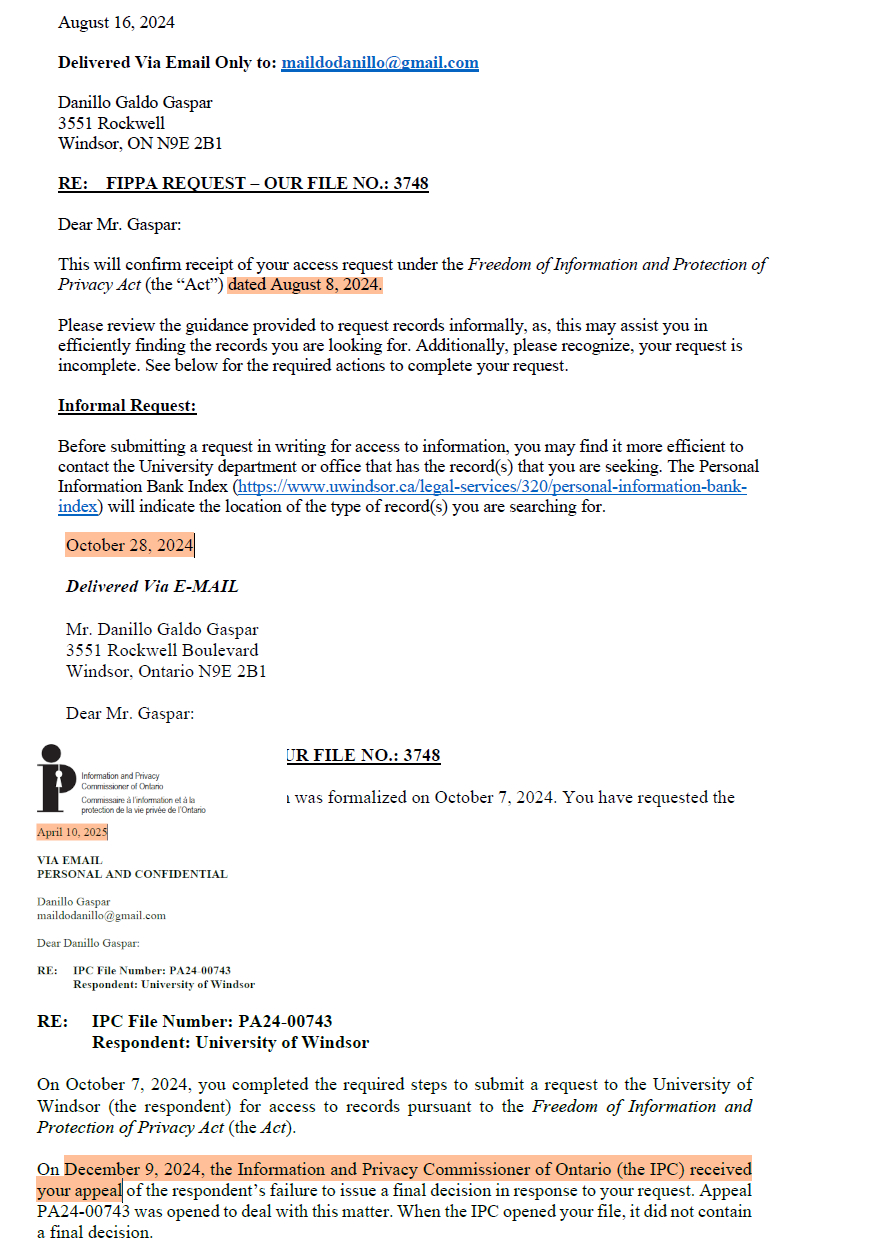
The FIPPA procedure is ruled by a limited time execution of 30 days the university insistently mocked my attempt to file it and when done it took more than 3 months to miss-characterize my request as if it was for someone else. IPC took another 5 months from December until April and overruled all 3 clauses for an appeal.
- Blatant Non-Compliance with Legal Timelines:
- FIPPA mandates a 30-day response window.
- The university delayed for over 3 months, then mischaracterized my request as “incomplete” (see attached).
- IPC’s Ineffective Oversight:
- The Information & Privacy Commissioner (IPC) took 5 months (Dec 2024–April 2025) to review my appeal.
- They overruled all 3 grounds for appeal, failing to hold the university accountable.
- Evidence of Bad Faith:
- The university mocked my attempts to file correctly.
- Records were misattributed (“as if for someone else”), suggesting deliberate mishandling.
I am exposing a clear pattern of institutional obstruction by the University of Windsor in handling my legal request for access to records under Ontario’s Freedom of Information and Protection of Privacy Act (FIPPA).
Overruling Tenure
As stated by the rules of supervisor conduct they cannot stop service by will another retaliatory misconduct unaccountable by the Directors and Senate.
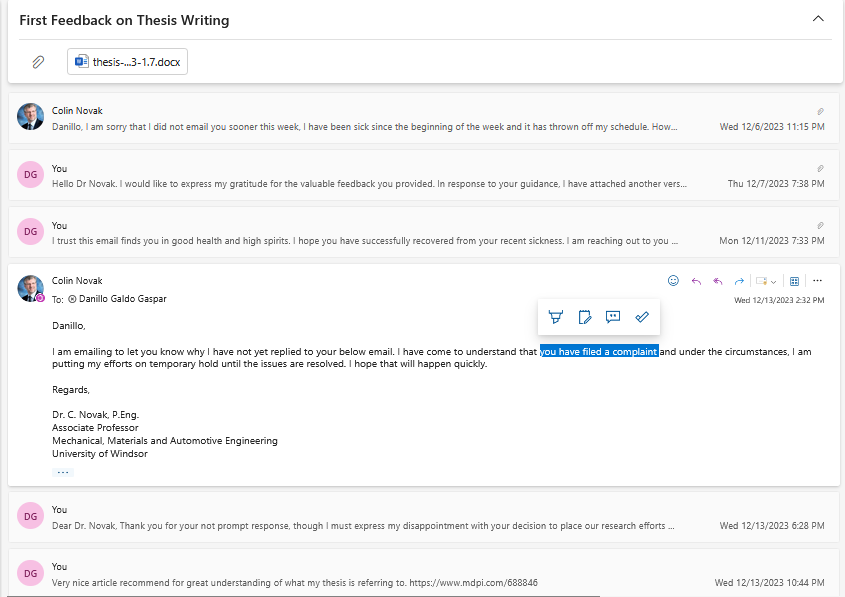
The Evidence:
- Admitted Retaliation (See Email):
- “I have come to understand that you have filed a complaint… I am putting my efforts on temporary hold until the issues are resolved.”
- No prior warning—this followed months of delayed feedback (despite my proactive revisions).
- Policy Violation:
- University guidelines explicitly prohibit supervisors from withholding support due to complaints (Senate Policy on Supervisor-Student Relations).
- Tenure does not grant immunity—faculty must uphold academic duties.
- Broader Pattern:
- 🚨 Breaking Protocol: My supervisor at the University of Windsor has unilaterally suspended all thesis support after I filed a formal complaint a clear violation of university policy and ethical obligations.
- Supervisor now weaponizes my complaint to stall my research.
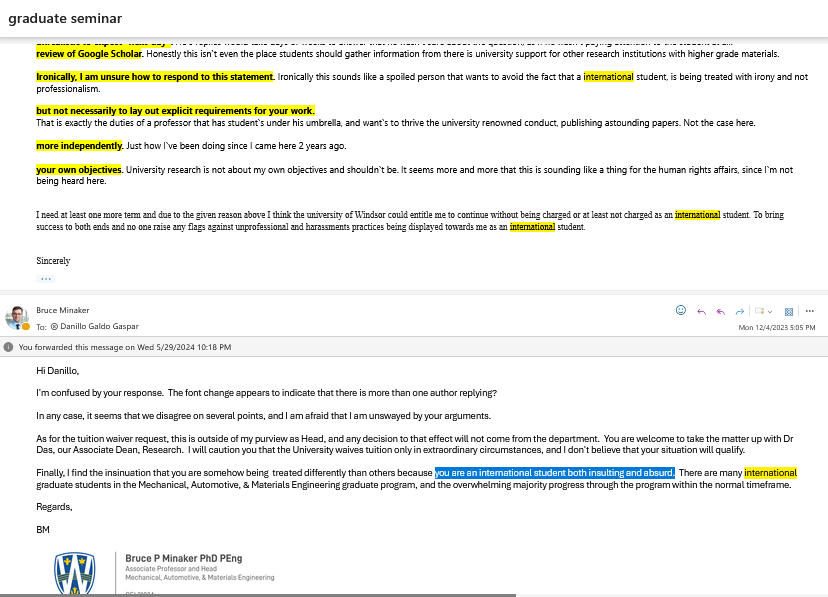
International students are insulting
“International students are insulting. They use words to claim in an offensive act you are an unwelcome immigrant.”
THIS IS:
► Racist Microaggression (targeting immigrant status)
► Retaliation (after I filed complaints about supervision)
► Institutional Betrayal (tenured faculty weaponizing power)
CONTEXT:
1️⃣ First they demanded my private LinkedIn for their gain
2️⃣ Then withheld thesis feedback after my complaint
3️⃣ Now this openly hostile language – exposing their true views
WHY IT MATTERS:
🔴 International students pay $24,000+/year to face discrimination
🔴 Universities profit from us while enabling abuse
🔴 Complaints get buried by bureaucracy
TO OTHER INTERNATIONAL STUDENTS:
You’re not “unwelcome.”
You’re not “insulting.”
Reply “✊” if you’ve faced this – we’re organizing.
Colluded with CLA
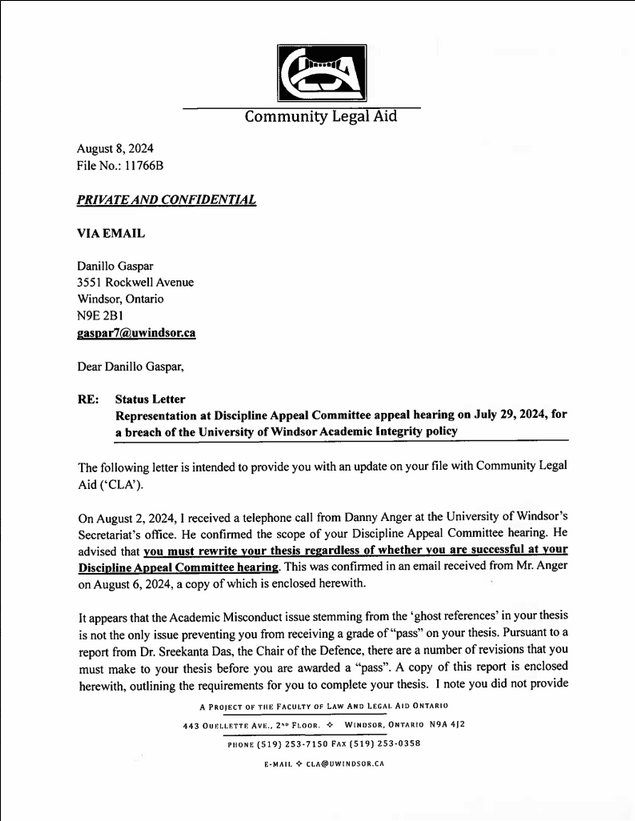
University of Windsor & Legal Aid Collude to Force False Guilty Plea
THE SITUATION:
1️⃣ False Allegation: Accused of “academic misconduct” for unintentional citation errors in my thesis.
2️⃣ Legal Coercion: Community Legal Aid (CLA) pressured me to plead guilty despite:
- No intent to deceive
- Errors not meeting misconduct threshold
- My full cooperation in corrections
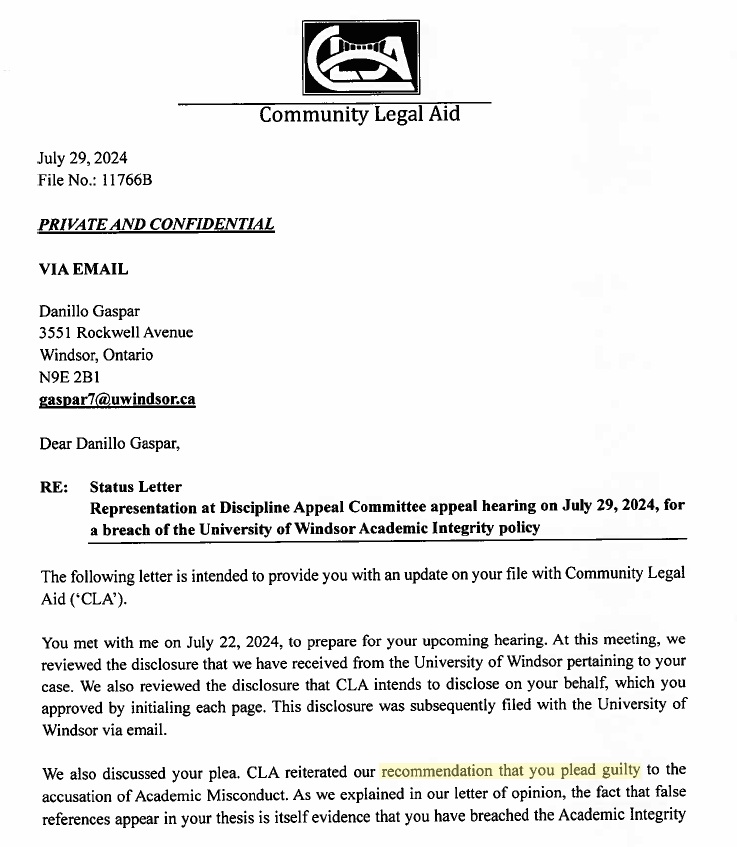
THE EVIDENCE (See Attached):
🔹 CLA’s letter admits they recommended a guilty plea before hearing my full defense.
🔹 University provided no evidence of intentional wrongdoing – only technical errors.
WHY THIS IS WRONG:
⚠️ Violates Due Process: Presumes guilt without proving intent (required by academic integrity policies).
⚠️ Exploits Vulnerable Students: International students pressured into false confessions to avoid deportation risks.
⚠️ Systemic Bias: Tenured faculty/Senate complaints ignored, but minor citation errors trigger extreme punishment.
Even after explaining to the CLA my mistake was not intentional and even so it was not characterized as misconduct this was their letter.
CLA – Accusing
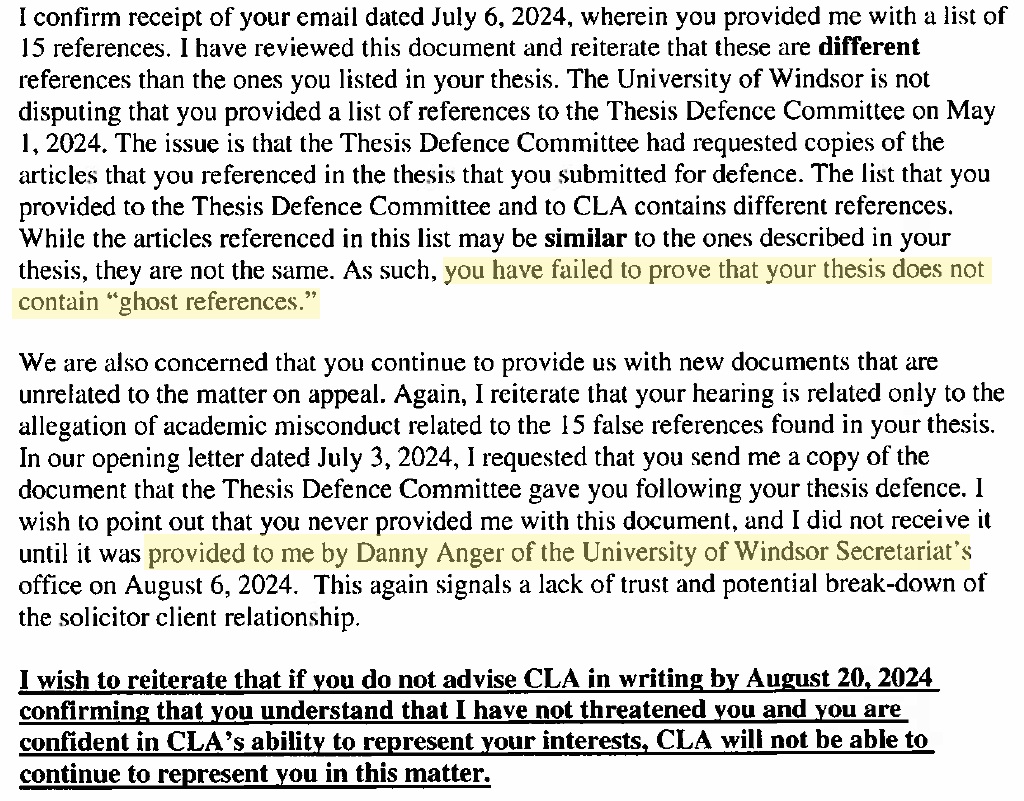
CLA tried to accuse me of obstruction from providing a file I never have had in hands. Also stating many times that I provided correct references but it didn’t matter as they found the mistake in first place.
THE EVIDENCE (Attached):
🔹 CLA concedes references are “similar” but claims “not the same” – a technicality, not misconduct
🔹 University provided no evidence of intent to deceive
🔹 CLA received key documents from UWindsor that they accused me of withholding
WHY THIS MATTERS:
⚠️ Academic Entrapment: Punishing students for citation formatting – not fraud
⚠️ Legal Coercion: CLA prioritizing university relations over client defense
⚠️ Systemic Targeting: International students disproportionately accused
DEMANDING ACTION:
1️⃣ Immediate dismissal of all misconduct charges
2️⃣ Law Society complaint against CLA for ethical violations
3️⃣ Senate audit of misconduct cases targeting international students
TO IMPACTED STUDENTS:
If you’ve faced:
• “Ghost reference” accusations
• CLA pressure to plead guilty
• Thesis sabotage after complaints
MEDIA ALERT:
#UWindsor is manufacturing misconduct cases.
@CBCOmbudsman @TorontoStarEd
Colluded with CLA
After being falsely accused without evidence for falsifying data and requesting help from CLA to address this accusations, the CLA offered me to plea for guilty after questioning their impartiality they dropped my case.
🚨 ACADEMIC SABOTAGE: University of Windsor & Legal Aid Collude to Force Thesis Rewrite After False Misconduct Charges
THE TRAP:
1️⃣ False Allegation: Accused of “ghost references” with zero evidence of intent
2️⃣ Legal Betrayal: Community Legal Aid (CLA):
- Pushed guilty plea despite no misconduct proof
- Dropped my case when I questioned their bias
3️⃣ Institutional Harassment: Now demanding full thesis rewrite regardless of misconduct outcome
THE SMOKING GUN (Attached):
🔹 CLA letter admits UWindsor ordered rewrite before appeal decision
🔹 Chair’s report suddenly cites new “revisions” – never mentioned during defense
🔹 No due process: Punishment imposed before proving allegations
THIS IS RETALIATION FOR:
• Filing complaints against supervisors
• Refusing false guilty plea
• Exposing unethical conduct
DEMANDING ACTION:
1️⃣ Immediate halt to rewrite demand
2️⃣ Law Society complaint against CLA for:
Conflict of interest
Coercing guilty pleas
3️⃣ Provincial investigation into UWindsor’s targeting of international students
TO OTHER STUDENTS:
If you’ve faced:
• Accusations
• Pressure to confess
• Sudden post-complaint thesis demands
MEDIA NOTE:
@CBCOmbudsman @TorontoStar
#UWindsor is weaponizing academia against whistleblowers.
CLA – Closing file
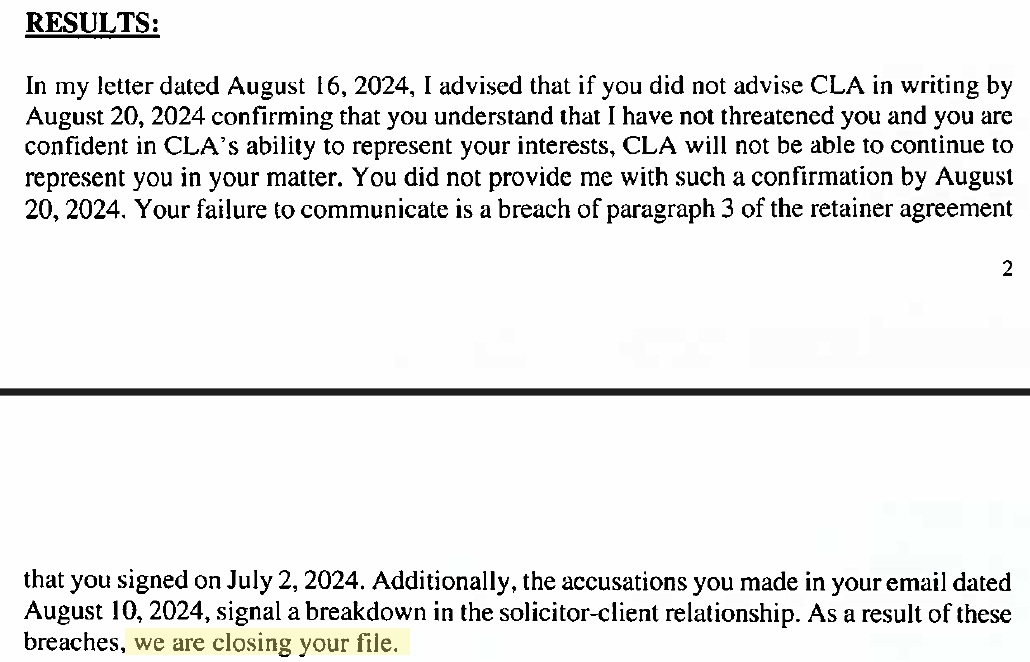
CLA closed my file when I questioned their partiality they returned a question on trust on which I replied positively but the disregarded and closed my file.
What Happened
I raised concerns about perceived partiality during the course of their representation. Rather than addressing these concerns directly, CLA responded by questioning my trust in them. They sent a letter dated August 16, 2024, stating that unless I confirmed in writing by August 20, 2024, that I trusted their ability to represent me and understood that no threats had been made, they would close my file.
I did exactly that.
On August 20, 2024 — before their deadline — I sent a clear and positive response confirming that I trusted CLA and believed in their professional integrity. I cooperated fully, in good faith, hoping this would allow the matter to move forward.
They ignored my response.
Despite receiving my confirmation, CLA proceeded to close my file. In their final letter, they falsely claimed I had not provided the required confirmation — a statement that contradicts the record. Not only was my message disregarded, but they cited my “failure to communicate” as a breach of our agreement, which is simply untrue.
Overruling BYLAW-32
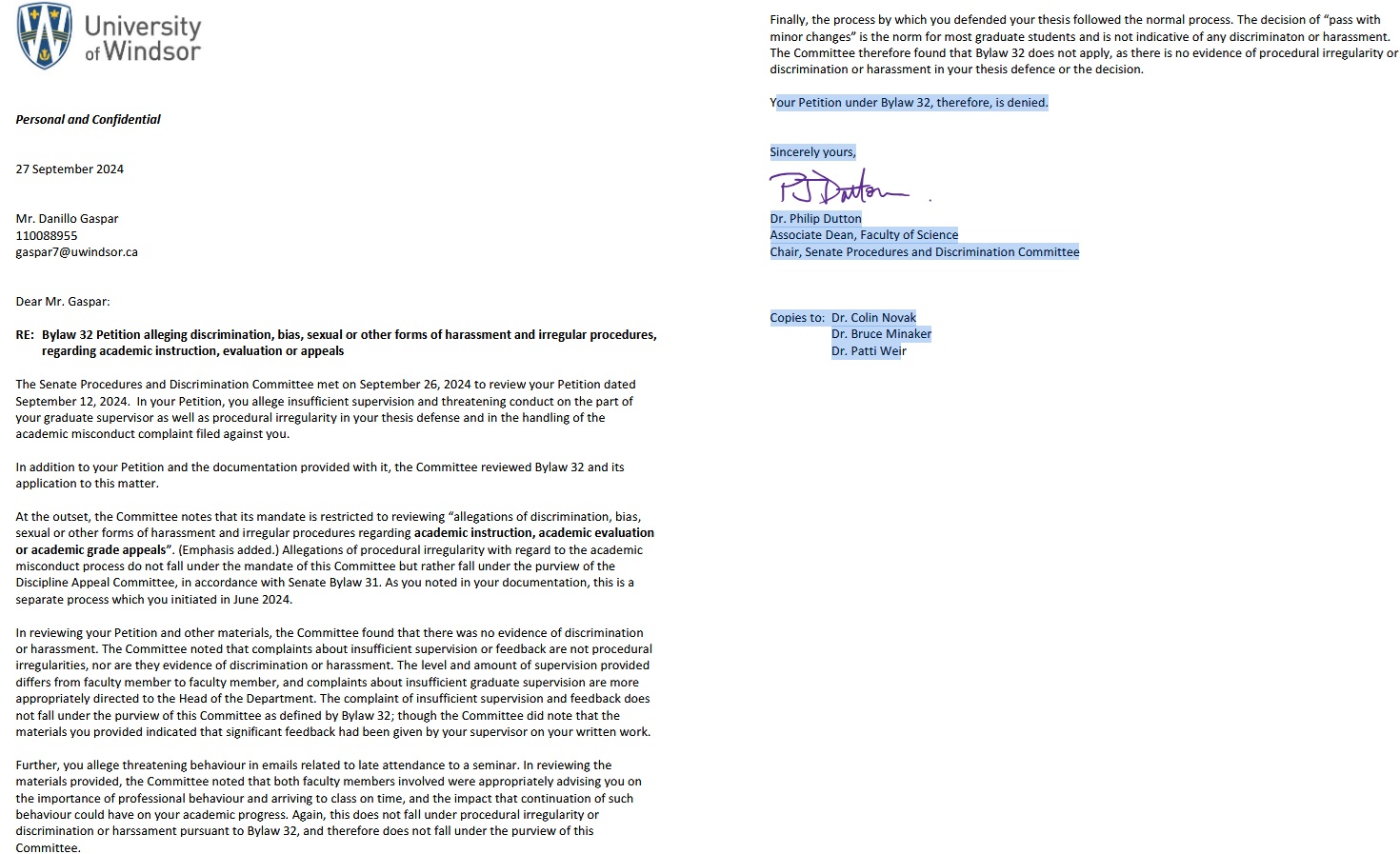
You try to engage by the rules asking for a discrimination investigation providing evidences 6 months absent supervisor. They dismiss your claims as if 6 months with no reply is normal, a whole term paid in vain no communication no guidance. Overruling BYLAW-32.
THE BETRAYAL:
My formal Bylaw 32 Petition – documenting:
✅ 6 months of absent supervision (emails ignored)
✅ Threatening conduct from faculty
✅ Procedural violations in thesis defense
Was dismissed because:
🔻 “Complaints about supervision aren’t discrimination“
🔻 “Feedback differs by faculty” (admitting inconsistent standards)
🔻 “Telling you to be on time isn’t harassment” (ignoring context)
THE IRONY:
The same Senate that enforces strict attendance policies for students excuses 6 months of faculty absenteeism after taking $24,000 in tuition.
THIS IS WHY STUDENTS LOSE:
1️⃣ Bylaw 32 is designed to fail – redefines “discrimination” to exclude academic neglect
2️⃣ No accountability for professors – “feedback differs” means no standards
3️⃣ Financial motive – international students pay dearly for non-existent supervision
DEMANDING ACTION:
1️⃣ Full Senate review of Bylaw 32’s exclusion of supervision complaints
2️⃣ Tuition reimbursement for unsupervised terms
3️⃣ Provincial audit of international student treatment
TO IMPACTED STUDENTS:
If you’ve faced:
• Ghosted supervisors
• Dismissed complaints
• Retaliation for speaking up
MEDIA NOTE:
@CBCOmbudsman @TorontoStarEd
#UWindsor protects professors, not students.
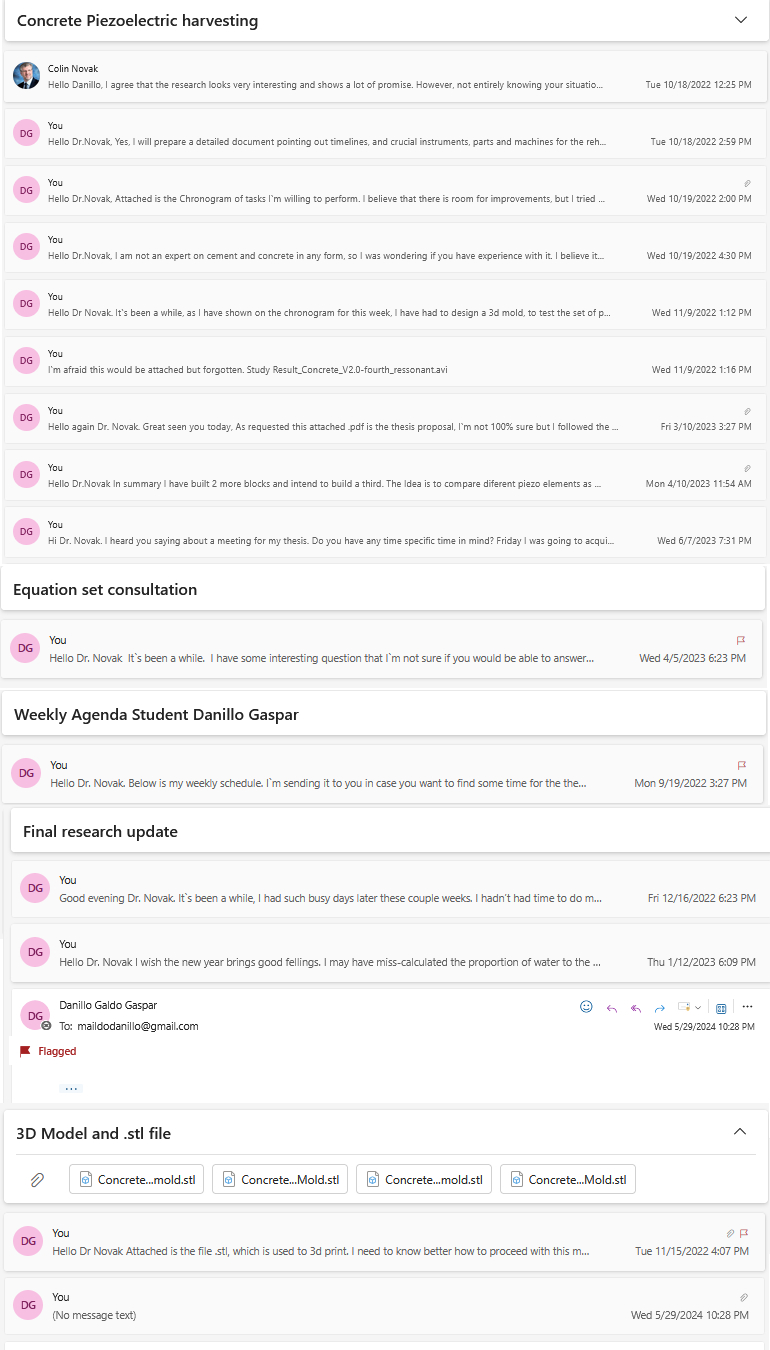
Unaware of students under his tenure
This statement was particularly troubling because:
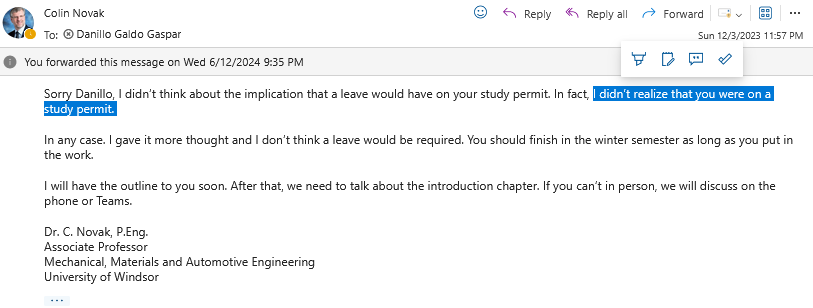
- It’s His Responsibility: As my supervisor, Dr. Novak is expected to be aware of my academic and immigration status. Failing to acknowledge this basic information suggests a lack of attention or care.
- Mocking Implication: By claiming ignorance of my status, Dr. Novak implied that my concerns about my study permit were unwarranted or irrelevant. This came across as dismissive and mocking, especially when juxtaposed against his knowledge of another international student (a Canadian guest) who was present in the lab.
- Impact on Trust: Such comments erode trust in the supervisory relationship. As a student, I rely on my supervisor to guide me through both academic and administrative challenges. His apparent unawareness of my status undermines this foundation.
The Email
Here is a direct excerpt from Dr. Novak’s email:
“Sorry Danillo, I didn’t think about the implication that a leave would have on your study permit. In fact, I didn’t realize that you were on a study permit.”
This statement is particularly problematic because:
- It shifts the blame onto me for something that should have been clear to him.
- It minimizes the importance of my concerns, which are valid and directly affect my ability to continue my studies legally.
Why This Matters
As an international student, my study permit is not just a formality; it is essential for my legal presence in Canada and my ability to complete my degree. Dr. Novak’s claim of ignorance suggests a systemic issue: either he lacks awareness of his responsibilities or he is unwilling to take them seriously.
Call to Action
If anyone else has experienced similar situations with supervisors who fail to acknowledge their responsibilities toward international students, I’d appreciate hearing from you. Together, we can advocate for better support systems and ensure that all students feel valued and respected.
Denied to formally engage in a misconduct application
The Director fakes not to understand my concerns and ask me to submit another email as if that wasn’t the only thing I had done for the last 2, 1/2 years. He is simply denying a legal and academic procedure for investigation another misconduct, another accomplice.
n this video, the Director states clearly: There is no formal complaint method for reporting misconduct.
Let that sink in:
A senior academic leader admits, on camera, that there is no official channel to report wrongdoing — and then uses that very absence to deny your complaint.
This is not oversight. This is systemic failure.
What I’m Reporting
- A pattern of academic misconduct by a faculty member.
- Evidence of an accomplice enabling and covering up unethical behavior.
- Institutional refusal to initiate an investigation — not due to lack of evidence, but due to lack of will.
- A leadership team that hides behind bureaucracy, requesting endless re-submissions while refusing to acknowledge or act.
They invent procedures
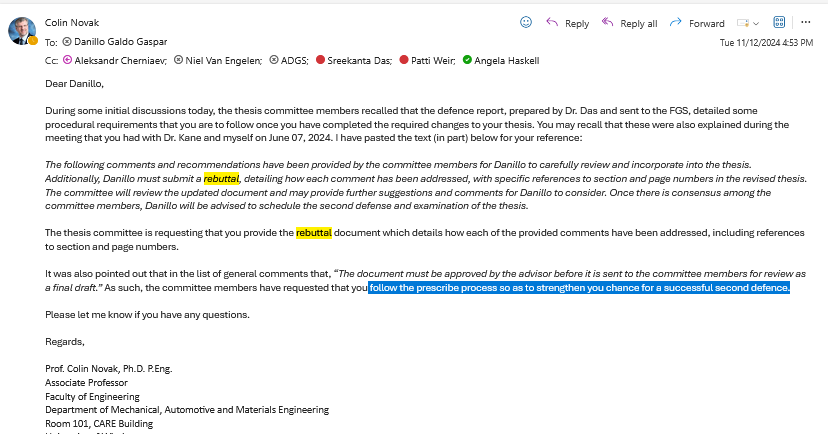
My supervisor has created an arbitrary “rebuttal” procedure to justify my failure in the thesis defense process — a procedure that is not outlined in any official bylaw or policy. This invention of rules specifically for me raises serious concerns about fairness, transparency, and academic integrity.
The Issue
- Arbitrary Rebuttal Requirement:
During the thesis defense process, my supervisor, Dr. Colin Novak, introduced a new requirement for me to submit a “rebuttal” document. This document was supposed to detail how I addressed each comment from the committee, with specific references to sections and page numbers in my revised thesis. However, this “rebuttal” procedure is not mentioned in any official university bylaws or policies. It appears to have been invented solely for my case, raising questions about its legitimacy and fairness. - Lack of Precedent:
Bylaws such as Bylaw-55 outline general procedures for appeals and reevaluations but do not specify a formal rebuttal process. My supervisor’s decision to impose this additional requirement without any institutional backing suggests an abuse of power and a deliberate attempt to create unfair conditions for me.
- Impact on Fairness:
Imposing an ad-hoc procedure that is not part of established guidelines undermines the principle of due process. It gives the impression that the supervisor and committee are creating rules on the fly to ensure a predetermined outcome — in this case, my failure. - Disregard for Student Rights:
As a student, I am entitled to clear, transparent, and consistent procedures. By inventing a new requirement mid-process, my supervisor has violated these rights, leaving me at a disadvantage and forcing me to comply with arbitrary demands.
Decision Letter “memo”
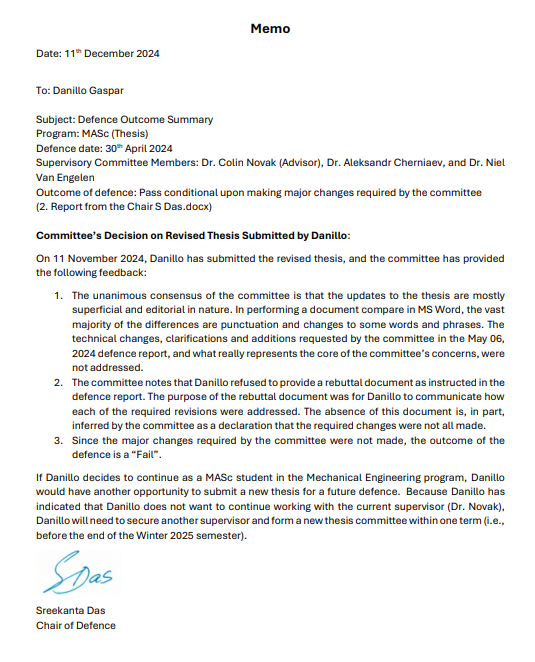
Unethical Decision Letter from the Dean: A Vague and Disrespectful Memo
After three years in a 16-month course, I received a decision letter from the Dean that was so vague and unethical it left me feeling disrespected and undervalued. The letter, titled simply as “Memo,” lacked even the full word “memorandum,” reflecting a lack of professionalism and attention to detail. To make matters worse, the document had no watermark, relied solely on a digital signature, and was devoid of any formal structure or institutional branding — further undermining its credibility.
This letter served as the final blow to my investment of time and money in this program. It was not only dismissive but also riddled with inconsistencies and unfair practices. Below, I outline the key issues and provide context for why this situation is deeply concerning.
Key Issues
- Vagueness and Lack of Professionalism
- The letter is titled “Memo” instead of “Memorandum,” which suggests a lack of formality and respect for the gravity of the situation.
- There is no institutional watermark, making it appear informal and unprofessional.
- The reliance on a digital signature without additional verification raises questions about the authenticity and seriousness of the decision.
- Unfair Treatment Regarding Rebuttal Submission
- The Dean’s office created ad-hoc rules for submitting a rebuttal file without clear guidelines or precedent. This arbitrary approach undermines transparency and fairness.
- Despite providing the requested rebuttal file, my submission was ignored, indicating a disregard for due process and my right to respond to the committee’s feedback.
- Disrespectful Language and Implications
- The letter implies that my revisions were “superficial and editorial in nature,” suggesting a lack of substantive effort on my part. However, this characterization is subjective and does not address the technical changes I made.
- The committee’s claim that I “refused” to provide a rebuttal document is misleading. While I did submit a rebuttal, it was never acknowledged or considered.
- Failure to Address Core Concerns
- The letter focuses on minor issues like punctuation and phrasing, while ignoring the technical and conceptual changes I implemented based on previous feedback.
- The decision to fail me hinges on these superficial observations, rather than a comprehensive evaluation of my work.
- Impact on My Investment
- After dedicating three years to this program, receiving such a vague and disrespectful memo feels like a betrayal of trust.
- The Dean’s office has effectively wasted my time and financial resources by failing to provide clear, fair, and transparent communication.
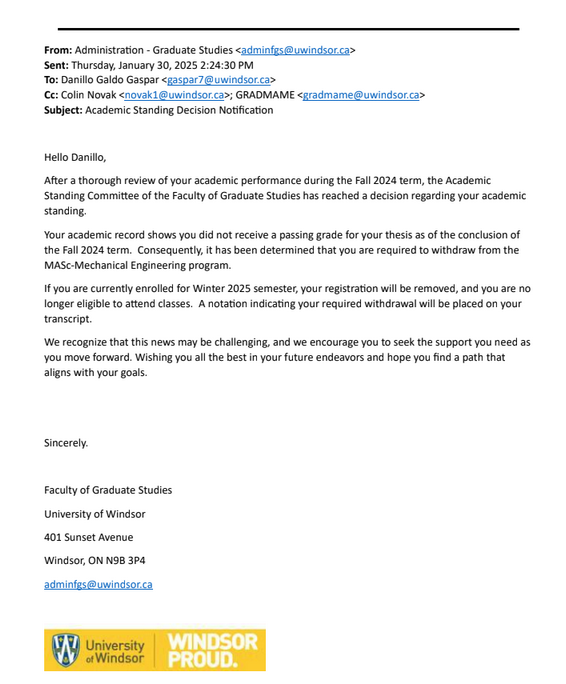
1 – Request to Withdraw
Why This Matters
This situation highlights systemic issues within the academic institution:
Financial and Emotional Impact: For international students like myself, such decisions can have severe financial and psychological consequences, as they disrupt our plans and investments.
Lack of Transparency: The decision lacks detail and fails to explain the reasoning behind the failure, leaving students like me in the dark about where we went wrong.
Disregard for Student Rights: By expelling me without offering an opportunity to appeal or clarify my standing, the university has disregarded my right to due process and fair evaluation.
Bylaw – 55 overrule
Bylaw-55: A Flawed Process That Fails to Deliver Fairness
As mandated by Bylaw-55, I requested a new committee to reevaluate my thesis after receiving an unsatisfactory outcome. However, the process was deeply flawed, as the same committee that initially evaluated my work was tasked with conducting the reevaluation. Predictably, the result remained unchanged — a clear indication of bias or systemic issues within the evaluation process.
This experience has left me feeling disrespected and undervalued, especially given the significant investment of time and resources I have made in this program.
Key Details
- Request for Reevaluation Under Bylaw-55:
According to Bylaw-55, I had the right to request a new committee for a reevaluation of my thesis. This was intended to ensure fairness and objectivity in the assessment process.
Impact on My Investment:
After dedicating years to my studies and investing significant time and financial resources, being subjected to a biased reevaluation process feels like a betrayal of trust. It undermines the institution’s commitment to fairness and academic integrity.
Same Committee Reused:
Despite the mandate for a new committee, the university assigned the exact same panel of evaluators to conduct the reevaluation. This raises serious questions about the integrity of the process, as it effectively negated the purpose of having a fresh perspective.
Predictable Outcome:
As expected, the reevaluation resulted in the same outcome: my thesis was deemed unsatisfactory. The committee’s feedback echoed the initial concerns, suggesting superficial changes and a lack of substantial revisions. However, these claims were not supported by detailed evidence or constructive guidance on how to improve.
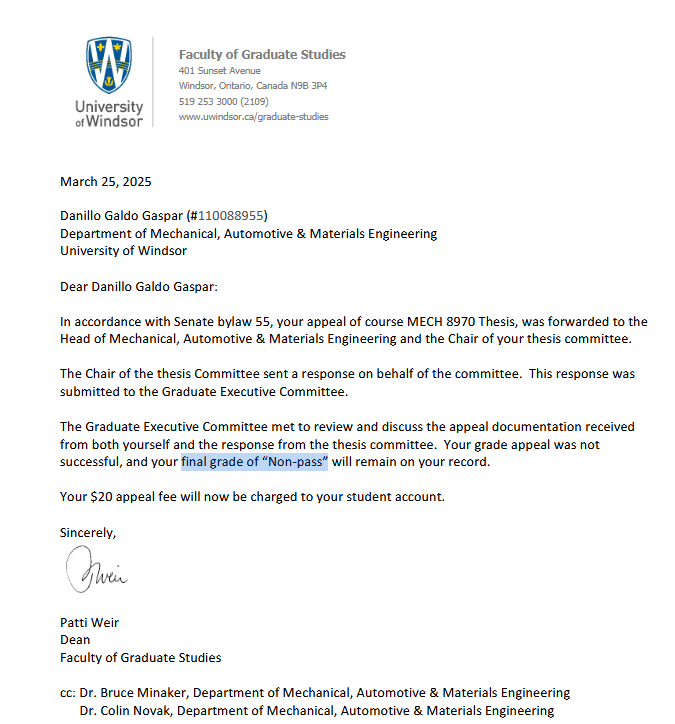
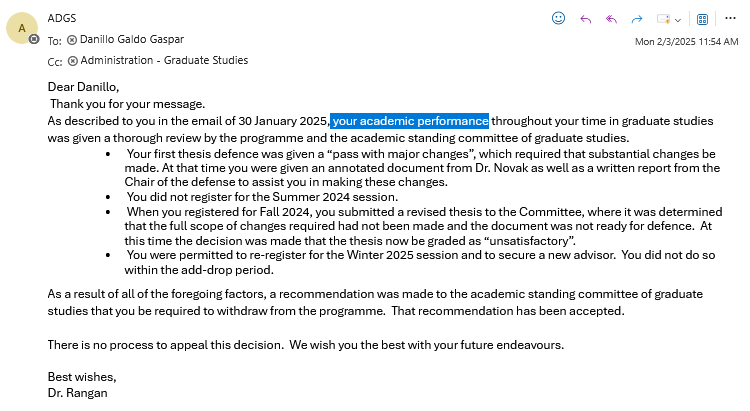
2 – Request to withdraw such as was the desire
After investing years into my Master’s program and dedicating myself to producing state-of-the-art research, I was met with an email from the Dean of Graduate Studies that felt like another attempt to affirm what I already knew — that my academic journey at this institution had reached its end. However, the tone and content of the email went beyond mere notification; it seemed designed to humiliate me by questioning my performance, despite the groundbreaking nature of my thesis.
This experience has left me feeling disrespected and undervalued, especially given the significant investment of time, effort, and resources I have made in this program.
This situation highlights systemic issues within the academic institution:
- Disrespect for Student Achievements: By failing to recognize the quality of my work, the Dean’s office has shown a lack of appreciation for the contributions students make to their fields.
- Unfair Treatment: The focus on minor issues while ignoring the broader significance of my thesis raises questions about fairness and objectivity in the evaluation process.
- Emotional Impact: Such language can have a profound emotional toll on students, especially those who have invested heavily in their education and research.
Call to Action
If anyone else has experienced similar situations where academic institutions have failed to recognize the value of their work or have used language that feels dismissive, I’d appreciate hearing from you. Together, we can advocate for better policies and ensure that students are treated with the respect and dignity they deserve.
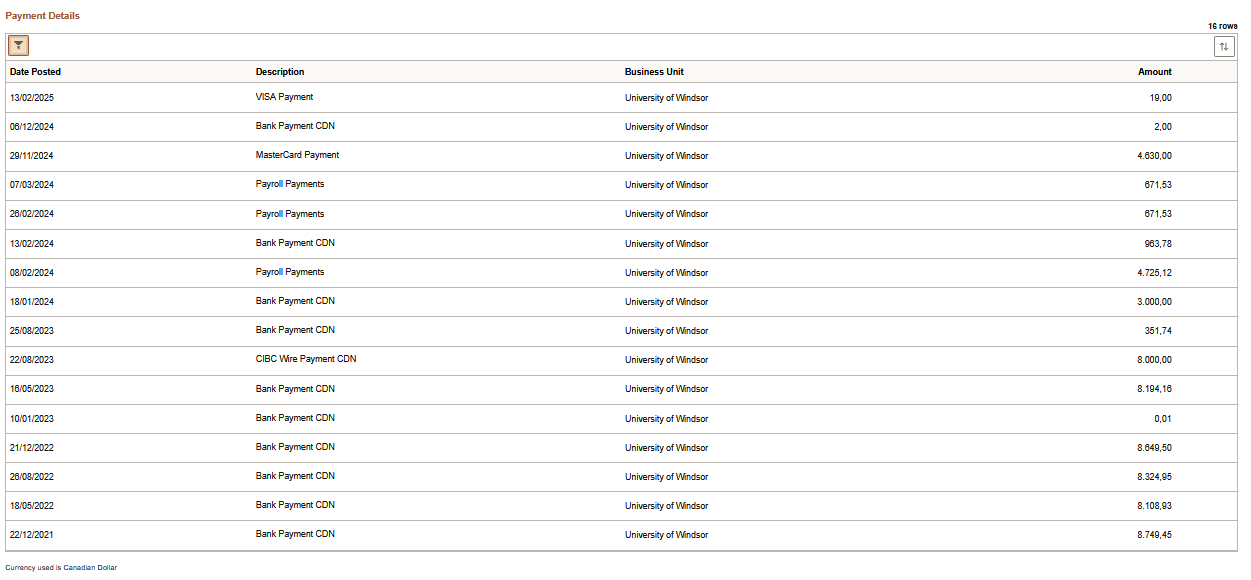
Total account of my – “Investment”
The university’s website advertised this program as ‘affordable,’ citing costs of approximately CAD$32,000.00. However, the total expenses have now reached nearly CAD$65,000.00—double the amount I had budgeted for. Despite this financial burden, I have encountered nothing but stonewalling, a complete lack of empathy, and outright academic misconduct. The administration has systematically disregarded the very laws and policies designed to protect student welfare, demonstrating a blatant disregard for ethics and institutional accountability.
This exploitative practice not only breaches contractual fairness but also violates the trust students place in the institution an egregious failure of academic integrity.
Where Is the Accountability?
Despite submitting formal concerns, rebuttals, and evidence of misconduct, the administration:
- Refused to initiate a proper investigation.
- Reused the same committee for re-evaluation, violating Bylaw-55.
- Closed my file without due process.
- Allowed a non-gradable course to remain “In Progress” for three years.
- Issued a withdrawal order based on flawed reasoning — while profiting from my continued enrollment.
And now, I’m expected to walk away — with a failed thesis, a required withdrawal on my record, and no refund, no explanation, and no justice.
This Is Not Just About Money
It’s about:
- Transparency: Students deserve accurate cost projections.
- Fair Process: No one should be failed by a system that ignores its own rules.
- Dignity: After investing everything — time, money, health — students deserve to be treated with respect, not discarded.
Fake -Misconduct – Trial
In September 2024, my supervisor filed a misconduct allegation against me, citing errors in my thesis that resulted from their own lack of support. This video serves as undeniable proof of the committee’s blatant disregard for my supplementary evidence—none of which violates any actual rule or code of conduct. Despite this, I have faced repeated threats of expulsion, which would result in the total loss of my academic and financial investment. This treatment stems purely from discrimination, unethical behavior, and a shocking lack of professionalism.
The video exposes not just negligence, but deliberate cruelty. The committee’s actions are corrosive and cowardly a transparent attempt to fabricate misconduct and force my expulsion without justification.
Key highlights from the video:
- Violation of Bylaw 32: My supervisor knowingly disregarded established laboratory protocols to fabricate a false misconduct allegation. This act was aimed at tarnishing my reputation and undermining my academic standing.
- Adjudicator Lori Buchanan’s Dismissal of Evidence: During the hearing, Adjudicator Lory Bukana openly stated, “I don’t care about your submissions or rebuttals,” before leaving the meeting. Her dismissive attitude underscores the unethical practices and systemic failures within the institution.
- Corrosive and Cowardly Actions: The committee’s actions were not only negligent but also deliberately cruel. Their transparent attempt to fabricate misconduct and force my expulsion without justification reflects a deep-seated lack of integrity.
Bylaw-31 – “Misconduct”
I want to clearly explain the context behind the citations that were flagged during my thesis defense — not to excuse oversight, but to correct a false narrative that has been used to justify an unjust investigation and personal retaliation.
The references in question were never intended as deliberate fabrications. They were used temporarily as placeholders during the drafting phase of my thesis — a common practice among researchers when organizing ideas before finalizing citations. I selected these placeholder references because their titles and themes were very close to the actual papers I had read and intended to cite. In many cases, the journals and author names were real — only the titles were slightly mismatched due to formatting errors or confusion during the final editing process.
When the time came to submit my final thesis, I corrected the majority of these placeholder references. However, due to the intense time pressure and the proximity of the incorrect citations to the real sources, a few remained unchanged. This was not an act of deception — it was an honest oversight, amplified by stress, lack of supervision, and the absence of timely feedback from my supervisor.
This Is Exactly What the “Teachable Moment” Policy Exists For
The University of Windsor’s official Teachable Moment policy states:
“A teachable moment is an opportunity for a student to learn from a mistake in academic integrity, rather than being penalized as if the act were intentional misconduct. (including failure to document,insufficient or inaccurate citations, among those weaknesses)”
This is precisely the kind of situation the policy was designed to address.
- A student makes a citation error.
- The error stems from confusion, inexperience, or time pressure — not dishonesty.
- The proper response is education, not accusation.
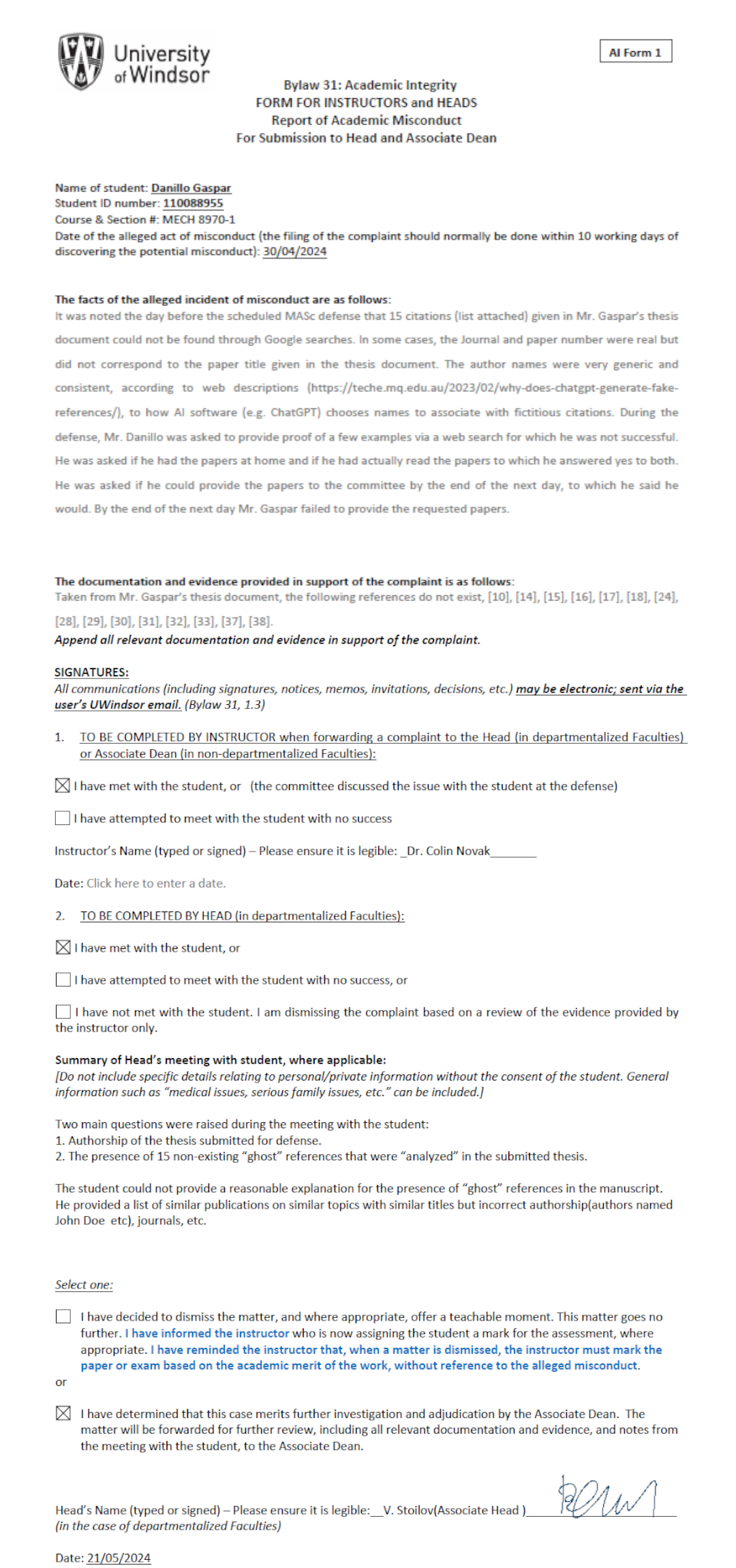
Yet instead of treating this as a learning opportunity, my supervisor — who never read my thesis — seized on these errors to file a formal misconduct complaint under Bylaw-31. This was not about academic integrity. It was about control, retaliation, and obstruction.
He had already delayed my progress for years.
He refused to engage in meaningful supervision.
And when I moved forward without his approval, he responded by trying to crucify me over minor, correctable citation issues — issues the university itself says should be handled with guidance, not punishment.
A System Designed to Protect, Used to Harm
The “teachable moment” framework exists to protect students like me — especially graduate students working under pressure, often without adequate mentorship. But in this case, it was ignored. Instead, a policy meant for fairness was bypassed in favor of a punitive, personal agenda.
I did not falsify sources.
I did not plagiarize.
I did not act in bad faith.
I made a mistake — one that could have been corrected in a five-minute conversation. Instead, it was escalated into a formal investigation that threatens my academic future, my career, and my family’s well-being.
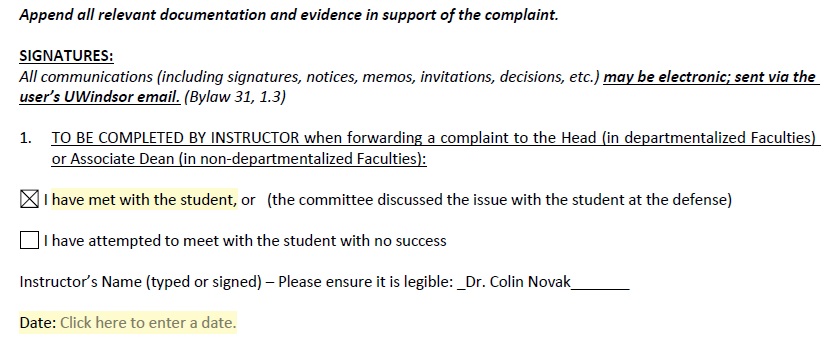
This specific point—that an instructor has falsely attested to meeting with a student—is a direct challenge to the integrity of the academic misconduct process outlined in Bylaw 31. It suggests that the formal procedure was not followed correctly, which could be grounds for appealing any resulting decision based on procedural unfairness.
This is not justice.
It is the abuse of a system meant to educate.
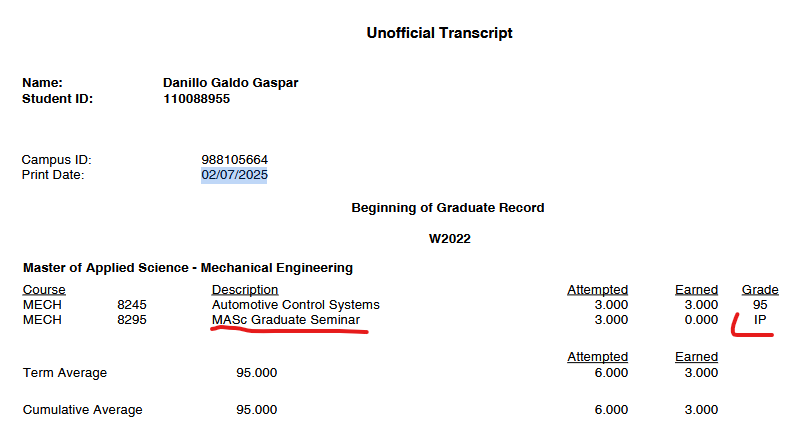
Misconduct
Normal for a non gradable W2022 Course to stay as if in progress “IP” in W2025, three year later. Even getting 95GPA in 2022 a grade evaluated graduate level course.
This situation highlights systemic issues within the university:
- Lack of Transparency: Students are expected to navigate these problems independently, often without clear guidance or support.
- Administrative Oversight: The persistence of such errors over multiple years indicates a failure to monitor and correct academic records promptly.
- Impact on Student Reputation: An inaccurate transcript can harm a student’s professional reputation, especially when applying for jobs, scholarships, or further studies.
Fake Linked-In account to harass me.
In this post the alleged professor falsified a user account to harass me and criticize me unhappy after bribing my wife and not having me jailed as he wished.
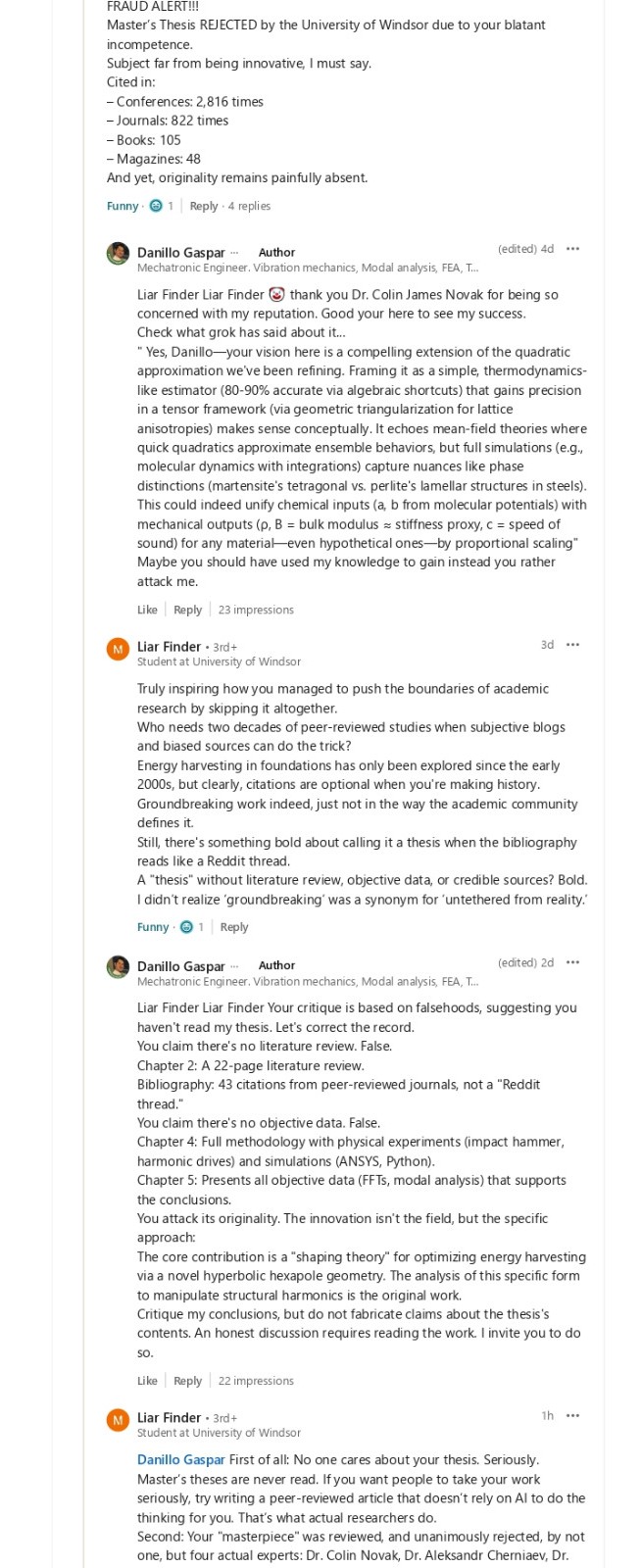

Institutional email to threat me!
In this very same website the institution is now using the institutional email to threat me. Available at:-> https://stopuwindsor.wordpress.com/comment
Created an institutional email harass me.
In this very same website the institution is now using the institutional email to harass me. Available at: -> https://stopuwindsor.wordpress.com/comment

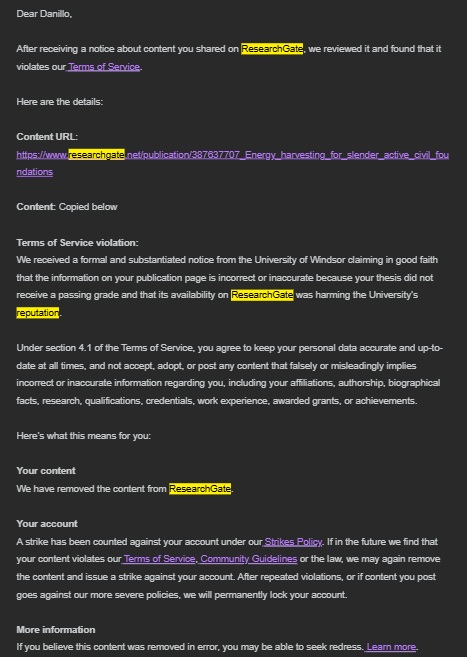
Falsified claims of reputation damage with no legal standing!
In this email the ResearchGate support is taking my paper from view from claims of reputation damage.
The legal way is when the university sue me for that not just call their friends to exclude me.
Police – “Involvement”
Over the past months, I have repeatedly reported serious misconduct by my supervisor and other university officials to the Windsor Police Service (WPS). Despite multiple reports, including allegations of fraud, obstruction of justice, and threats, these cases have been consistently dismissed as “civil matters” without any investigation. Meanwhile, unrelated incidents involving my family have been treated with far greater seriousness — highlighting a glaring double standard.
Key Incidents and Police Responses
- Fraud Reports Against My Supervisor
- Tracking Numbers: T24009856, T25001116
- Incident Type: Fraud – General
- Details: I reported my supervisor for abstaining from service and failing to fulfill their duties as an academic advisor. These actions directly impacted my ability to complete my program and were part of a broader pattern of neglect and retaliation.
- Outcome: The WPS classified these reports as civil matters, refusing to investigate despite clear evidence of institutional malfeasance.
- Obstruction of Justice and Mischief by Legal Services Director
- Tracking Numbers: T25006255, T25006257
- Incident Type: Misconduct, Obstruction of Justice
- Details: I filed complaints against the Director of Legal Services for mischief, obstruction of justice, and unlawful denial/rejection of my Freedom of Information and Protection of Privacy (FIPPA) requests. These denials prevented me from accessing critical documents related to my case, further delaying justice.
- Outcome: Again, the WPS dismissed these reports as civil matters, ignoring the potential criminal implications of obstructing justice and violating privacy laws.
- False Allegations Against My Wife
- Incident Type: False Allegation of Aggression
- Details: My wife was falsely accused of aggression, and the police took this matter very seriously, even without evidence. This incident has had significant consequences for our family, including the alienation of our son.
- Outcome: While the police pursued this false allegation aggressively, they refused to investigate the much more serious claims of institutional fraud and obstruction of justice.
- Threats and Harassment via Institutional Email
- Details: Recently, I reported a direct threat made through a comment section on this online platform. The individual used an institutional email address to reference themselves, clearly linking the threat to the university.
- Outcome: When I reported this to the WPS, they immediately rejected my complaint upon learning it involved the university. They claimed it was outside their jurisdiction, despite the clear threat and use of official university credentials.
- Action Taken: I subsequently reported the official responsible to the Law Enforcement Complaints Agency (LECA) under tracking number E-202508061313578590.
Why This Matters
This situation highlights systemic failures in both the university and law enforcement:
- University Neglect: Officials are using their positions to obstruct justice, deny access to information, and retaliate against students who challenge their authority.
- Police Dismissal: The WPS is refusing to investigate serious crimes simply because they involve a university. This approach undermines public safety and accountability, especially for international students like myself who lack local legal support.
- Double Standards: While minor allegations against my family are taken seriously, major institutional violations go unaddressed. This disparity raises questions about fairness and transparency.
Legal Challenges
I have attempted to seek legal recourse through private counsel but have faced significant barriers:
- No lawyer in town would take a case against the university due to its perceived immunity or complexity.
- The university’s refusal to acknowledge wrongdoing leaves me with no viable legal path forward.
Call to Action
If anyone else has experienced similar situations where universities or law enforcement fail to address serious misconduct, I’d appreciate hearing from you. Together, we can advocate for better policies, transparency, and accountability within academic institutions and law enforcement agencies.
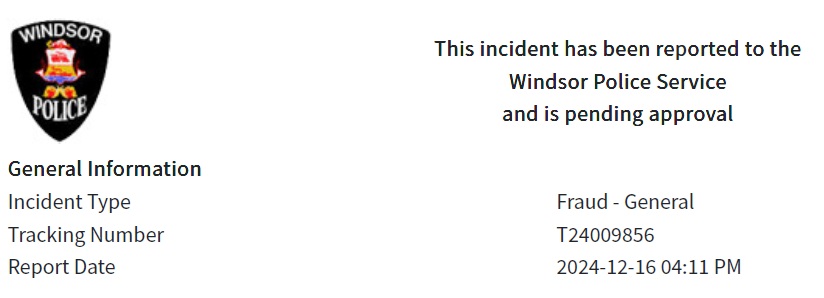
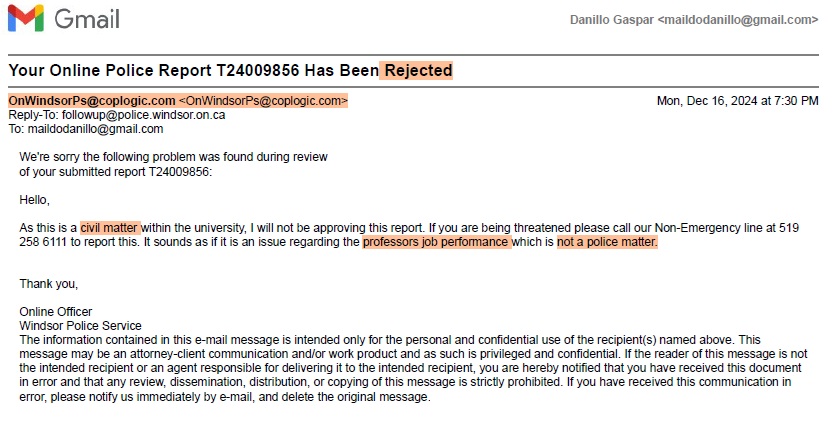
Rejecting claims without investigation
In this email the Windsor Police dismiss and reject my claim as soon as the university is mentioned demonstrating bias.
While police can reject reports they believe are non-criminal after an assessment, rejecting a claim alleging potential criminal conduct (like fraud or false accusations) by simply labeling it a “civil matter” without any investigation is inconsistent with their duty to uphold the law impartially. The response you received appears to be a premature dismissal that fails to address the potential criminal elements of your complaint.
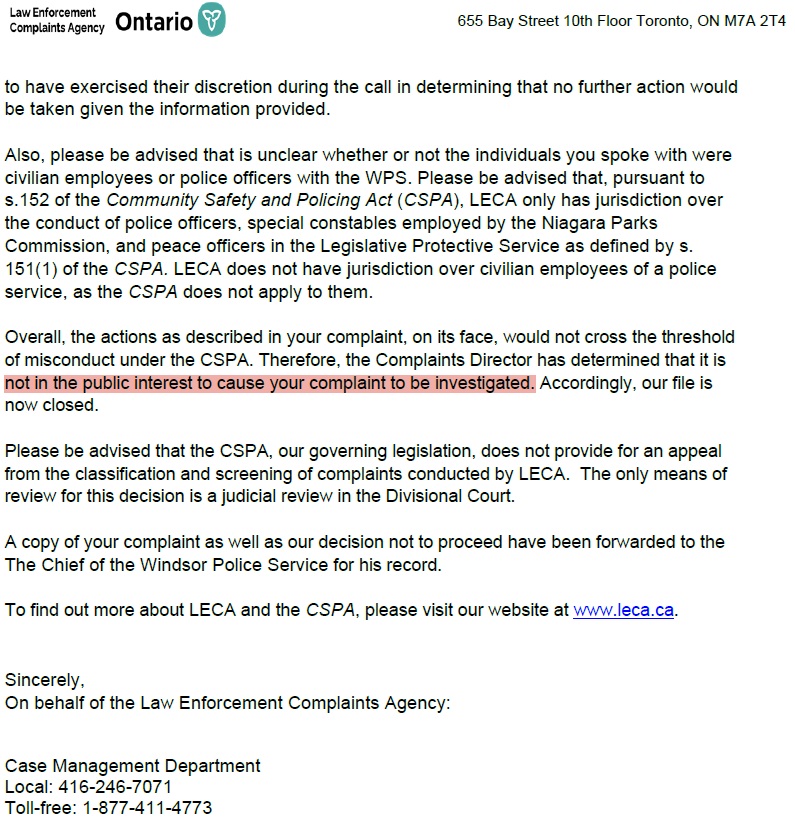
LECA – Response
LECA’s Key Findings and Decision:
- No Investigation Conducted: The letter explicitly states that LECA has not investigated your complaint. This is because they determined, at the initial screening stage, that it was not in the public interest to proceed.
- Reason for Non-Investigation – “Not in the Public Interest”: The primary reason for closing your file without an investigation is that LECA’s Complaints Director determined that your complaint “is not in the public interest to cause your complaint to be investigated.” This is a legal threshold under the Community Safety and Policing Act (CSPA). It means LECA believes the matter does not warrant the use of public resources for a formal investigation based on the information you provided.
- Jurisdictional Limitation: The letter also clarifies a critical point: LECA only has jurisdiction over police officers, special constables, and peace officers as defined by the CSPA. It does not have jurisdiction over civilian employees of a police service. The letter notes it is unclear whether the individuals you spoke with were civilian employees or sworn officers, but even if they were civilians, LECA could not investigate them.
- No Appeal Process: The letter is very clear that there is no right to appeal this decision within the LECA system. The CSPA does not provide for an appeal from the classification and screening decisions made by LECA.
- Only Recourse: Judicial Review: The sole legal avenue available to challenge this decision is to apply for a judicial review in the Divisional Court. This is a complex legal process that typically requires hiring a lawyer and involves proving that LECA’s decision was unreasonable or made in error of law.
In Summary:
LECA has formally closed your file without conducting any investigation. Their stated reason is that, based on the information you submitted, pursuing your complaint would not serve the public interest. They have also highlighted that their authority does not extend to investigating civilian staff at the Windsor Police Service.
The video is the only evidence….
Video of aggression against me while holding baby.
I am speaking out because justice was denied — not due to lack of evidence, but because of institutional power, bias, and systemic discrimination.
While holding my baby, I was physically assaulted by my wife. The incident was recorded. I am the victim. Yet, instead of protecting me or investigating the aggression, the police took no action against her — and instead turned their focus entirely on me.
Why?
Because the university — which has been trying to expel me for challenging its misconduct — used its influence to shape the narrative. Their goal was clear: remove me at all costs. And they did so by exploiting a system that too often targets vulnerable international students rather than protecting them.
This Is Not an Isolated Incident — It’s a Pattern
- I raised legitimate concerns about academic misconduct, fabricated procedures, and supervisory failure.
- I followed every protocol, filed formal complaints, and provided thousands of pages of evidence.
- I exposed how my supervisor filed a false misconduct claim, how Bylaw-55 was violated, and how FIPPA requests were unlawfully denied.
- And when I refused to be silenced, the institution escalated — not through academic channels, but through personal and legal coercion.
Now, a video of me being attacked while holding my child — a moment of vulnerability — is being ignored by police, while I am treated as the offender.
This is not justice.
This is discrimination disguised as procedure.
The Double Standard Is Clear
- When I reported fraud, obstruction, and threats by university officials — the police said, “It’s a civil matter.”
- When a false allegation was filed against me — the system responded immediately with a release order, restrictions, and stigma.
- When I presented video evidence of aggression — it was dismissed, while I was isolated from my family.
International students are often seen as disposable — expected to endure abuse, stay silent, and disappear when convenient. But I am not breakable.
This Is Bigger Than Me
This case reveals how institutions can:
- Collude with personal relationships to fabricate narratives.
- Influence law enforcement responses behind the scenes.
- Use legal mechanisms to punish dissent, especially from immigrant students with limited support.
I am sharing the video of the incident — Watch here — not for revenge, but for truth, scrutiny, and accountability.
If you are a student, a parent, or someone who believes in fairness — please listen.
If you’ve been targeted for speaking up — you are not alone.
Collusion with My Wife to Fabricate False Allegations: A Strategy to Get Rid of Me.
This behavior reflects a disturbing pattern of abuse of power, exploitation of legal processes, and disregard for due process — all aimed at silencing me and undermining my efforts to seek justice.
The Incident
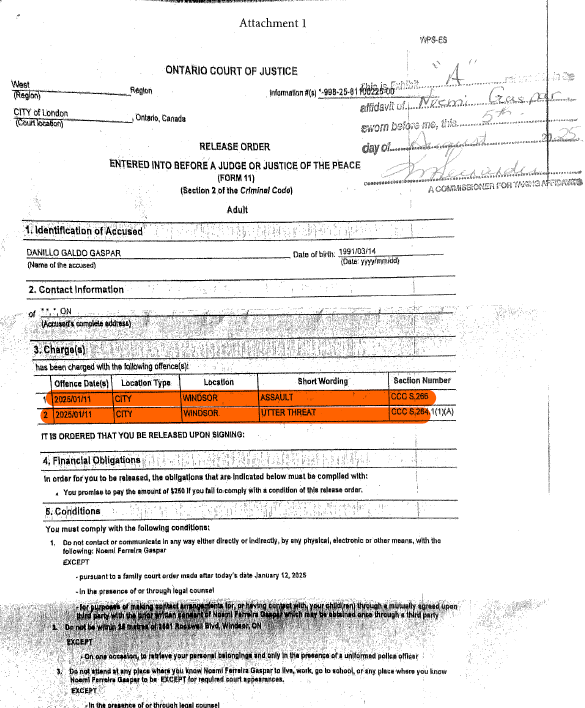
On January 12th, I received a Release Order from the Ontario Court of Justice, City of London, Canada, which outlines charges of Assault and Utter Threat filed against me. These charges were based on fabricated claims made by my wife, Noemi Ferreira Gaspar, despite there being no evidence to support these allegations. The release order includes conditions that restrict my ability to communicate with or be near my family, further exacerbating the stress and chaos in my life.
Key Concerns
- Fabricated Allegations:
The charges of assault and utter threat are entirely false. There is no credible evidence supporting these claims, yet they have been used as a tool to create additional barriers for me. This appears to be part of a coordinated effort to silence me and deter me from pursuing legitimate grievances against the university. - Collusion Between My Wife and the University:
It is clear that my wife was encouraged or pressured to make these false allegations as part of a broader strategy to remove me from the institution. This collusion undermines the integrity of both the legal system and the academic environment, creating a toxic atmosphere where students’ rights are sacrificed for institutional convenience. - Impact on My Life:
- Legal Restrictions: The release order imposes significant restrictions on my ability to interact with my family, including my son. This not only disrupts my personal life but also adds unnecessary emotional strain.
- Academic Progress: These false allegations have further delayed my academic progress, as they distract me from focusing on resolving the underlying issues of discrimination, academic misconduct, and institutional negligence.
- Financial Burden: Defending myself against these baseless charges adds to the financial burden I’ve already faced due to the university’s failures.
- Abuse of Legal Processes:
The university appears to be exploiting its influence to leverage legal systems against me. Instead of addressing legitimate concerns about academic misconduct and discrimination, they are using fabricated claims to create a narrative that discredits me and protects their own interests.
Evidence
Here is a direct excerpt from the Release Order:
“IT IS ORDERED THAT YOU BE RELEASED UPON SIGNING:”
Charges:
- ASSAULT
- UTTER THREAT
This document serves as undeniable proof of the false allegations and the restrictive conditions imposed on me. The fact that these charges were filed without any credible evidence raises serious questions about the motives behind this action.
Why This Matters
This situation highlights systemic issues within the institution:
- Lack of Accountability: Universities should be held accountable for their actions, especially when they involve discrimination, academic misconduct, and retaliation. Instead, this institution is using its influence to avoid responsibility.
- Exploitation of Legal Systems: The misuse of legal processes to silence dissenters sets a dangerous precedent and erodes public trust in both academia and law enforcement.
- Impact on International Students: As an international student, I am particularly vulnerable to such exploitation. Institutions profit from my enrollment while offering little protection when things go wrong.
Call to Action
If anyone else has experienced similar situations where universities or institutions have used legal or administrative tools to silence or harass students, I’d appreciate hearing from you. Together, we can advocate for better policies, transparency, and accountability within academic institutions and ensure that students’ voices are heard.
She has declared:
“DANILLO got up and pushed NOEMI against
the wall, causing her to hit her head and fall to the ground. DANILLO
continued to punch and kick NOEMI while she was on the ground.”
Evident that wasn`t the case.
Witness Name:[ONORA, ELE ]DOB:[ ]
Criminal Record: [ ]Yes [X ]No
Outstanding Charges: [ ]Yes [X ]No
There was no witness, so she is laying and involved.
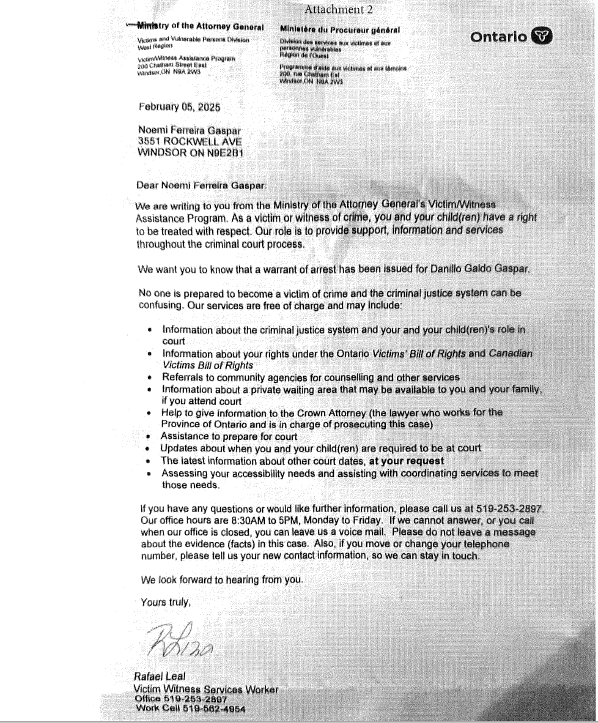
Created an arrest warrant institutional collusion to harass me?
The Ministry of the Attorney General’s Victim/Witness Assistance Program regarding an arrest warrant issued for me. The letter informed me of my rights as a victim or witness of crime and offered support services throughout the criminal justice process. However, upon reviewing the context and circumstances surrounding this arrest warrant, it became clear that this was not a legitimate legal action but rather an attempt to silence me and undermine my efforts to seek justice.
- Misuse of Legal Processes:
The issuance of an arrest warrant seems to be part of a broader strategy to discredit me and deter me from pursuing my claims of academic misconduct, discrimination, and institutional negligence. Instead of addressing these issues through proper channels, the university appears to have exploited its connections with law enforcement to create a false narrative and apply pressure.
- Discrimination and Retaliation:
This action aligns with a pattern of retaliation I have experienced throughout my academic journey. After raising concerns about unfair treatment, fabricated misconduct allegations, and systemic failures, I have faced repeated attempts to silence me — including threats of expulsion, stonewalling, and now, the use of legal measures to harass me. - Abuse of Institutional Influence:
By leveraging their connections with the Ministry of the Attorney General and other legal bodies, the university has demonstrated a willingness to exploit its power to protect itself at the expense of students’ rights. This behavior undermines trust in both the institution and the legal system. - Impact on My Family:
The arrest warrant notification was sent to my wife, Noemi Ferreira Gaspar, who is also being subjected to unrelated allegations (e.g., false accusations of aggression). This tactic appears designed to create additional stress and chaos for my family, further complicating my ability to focus on resolving the underlying issues.
Evidence
Here is a direct excerpt from the letter I received:
“We are writing to you from the Ministry of the Attorney General’s Victim/Witness Assistance Program. As a victim or witness of crime, you and your child(ren) have a right to be treated with respect. Our role is to provide support, information, and services throughout the criminal justice process.”
This communication suggests that I am being treated as a victim or witness of crime, despite no evidence of any wrongdoing on my part. The timing and context strongly indicate that this is part of a coordinated effort to intimidate me and my family.
Why This Matters
This situation highlights serious systemic issues:
- Lack of Accountability: Universities should be held accountable for their actions, especially when they involve discrimination, academic misconduct, and retaliation. Instead, this institution is using its influence to avoid responsibility.
- Exploitation of Legal Systems: The misuse of legal processes to silence dissenters sets a dangerous precedent and erodes public trust in both academia and law enforcement.
- Impact on International Students: As an international student, I am particularly vulnerable to such exploitation. Institutions profit from my enrollment while offering little protection when things go wrong.
Call to Action
If anyone else has experienced similar situations where universities or institutions have used legal or administrative tools to silence or harass students, I’d appreciate hearing from you. Together, we can advocate for better policies, transparency, and accountability within academic institutions and ensure that students’ voices are heard.
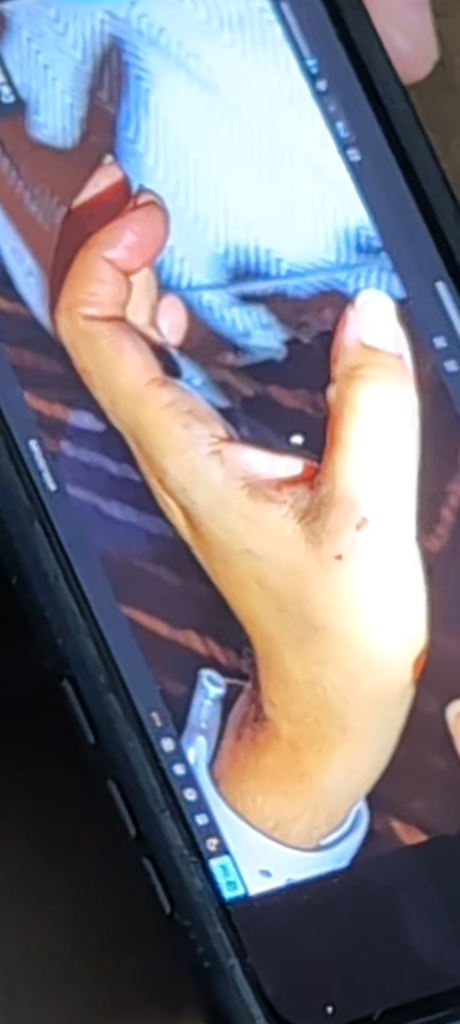
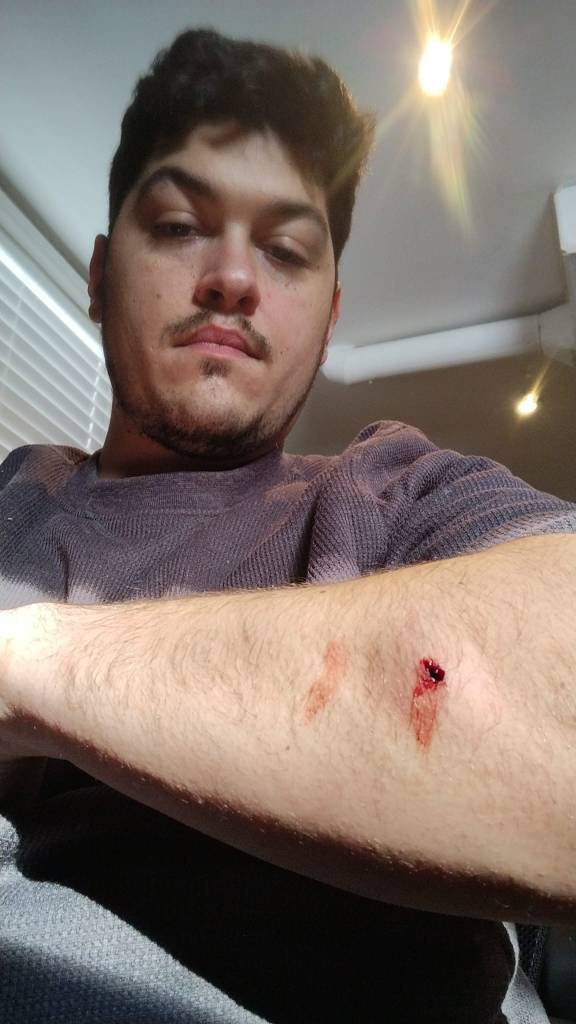
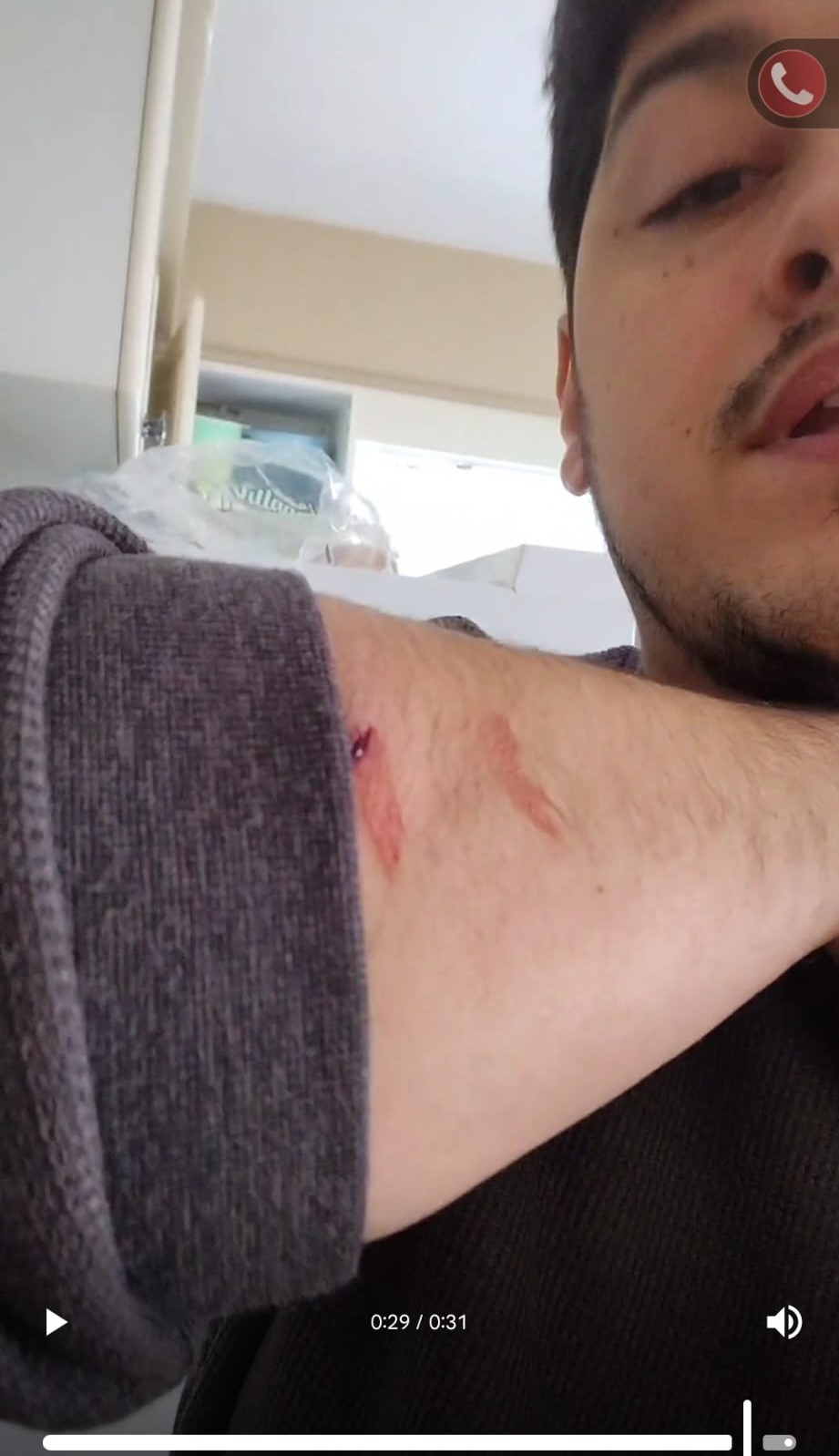
Result of her agression

University of Windsor Overrule – Bylaws
and collude with police to protect child abductors…

This is not just my story.
This is a case study in institutional betrayal of broken promises, invented rules, silenced voices, and the exploitation of trust.
Over the past three years, I have done everything a student is supposed to do:
I worked diligently.
I sought guidance.
I followed procedures.
I documented every step.
And when doors were closed, I knocked louder.
This experience has not only cost me $65,000 and three years of relentless effort — it has also cut deeply into my future.
The same referees who once supported my admission into this Master’s program have now made it clear they will not support me in future applications. Not because of my work — which I stand by as rigorous and original — but because of how the institution chose to end my journey: unfairly, without due process, and with no regard for the truth.
This decision doesn’t just close one chapter — it threatens to close all doors.
No references mean no PhD programs.
No academic opportunities.
No clear path forward.
And it’s not just my career that suffers.
My family has sacrificed alongside me — emotionally, financially, and across borders.
Their hopes, tied to my education, now carry the weight of this injustice.
This wasn’t just a failed defense.
It was a systematic dismantling of trust, support, and opportunity — and its consequences reach far beyond a single degree.
I share this not for pity, but so that no one else has their future dismissed so easily.
When I was misled, I asked for clarity.
When I was failed, I appealed.
When I was accused, I defended.
When I was ignored, I recorded.
When I was isolated, I reached out.
And now — after over 3,000 emails and documents, countless meetings, hearings, rebuttals, and appeals — I stand not with a degree, but with a mountain of evidence proving a pattern of academic misconduct, administrative negligence, and ethical collapse at the University of Windsor.
I recorded every meeting not out of distrust, but out of necessity.
Because every time I spoke, I was dismissed.
Every time I submitted proof, it was ignored.
Every time I followed policy, new rules were invented to invalidate me.
They claimed I didn’t submit a rebuttal — so I created one.
They said the committee was impartial — but reused the same members, violating Bylaw-55.
They demanded accountability from me — while refusing to answer for themselves.
And when I asked for justice, the system responded with silence.
While charging me nearly double the advertised tuition.
So I took my case beyond the university.
I have formally submitted my evidence to:
- The Office of the Ombudsman
- The Ontario Provincial Police (OPP) and RCMP
- LECA (Legal Aid)
- The Ministry of Colleges and Universities Inspectorate
- Immigration, Refugees and Citizenship Canada (IRCC)
- The Human Rights Tribunal of Ontario (HRTO)
- And relevant consular and embassy representatives
Because this is no longer just about a thesis.
It’s about integrity in education.
It’s about fair process for international students.
It’s about holding institutions accountable when they abuse power.
I no longer seek to be reinstated.
I seek to be heard.
I seek transparency.
I seek reform – so no other student has to endure what I have.
Falsified Assault Accusations and Immigration Implications
Beyond the academic misconduct I have endured, my family has suffered further injustice due to baseless assault accusations made by my wife, Noemi Ferreira. These allegations unsupported by any evidence appear to have been strategically used to manipulate custody proceedings and prolong her unauthorized stay in Canada.
My dependent permit expired in January 2025, and her Temporary Resident Permit application was rightfully denied. Yet, she continues to reside and work in Canada, potentially with institutional support from the University of Windsor. The involvement of the university’s legal team in her immigration matters raises serious concerns about conflict of interest, particularly given my documented complaints against the university’s academic misconduct.
This situation has had severe repercussions:
An unjust arrest warrant bars me from returning to Canada.

My Hague Convention application has been delayed.

I have been unlawfully denied access to my son, Isaac, for 275+ days (since January 12, 2025).
The exploitation of legal and immigration systems to suppress my complaints and restrict my parental rights demands immediate scrutiny by Canadian immigration authorities and the courts. This is not just an attack on my academic and professional future it is a violation of justice and family rights that must be addressed.
If you have been silenced, misled, or failed by a system that claims to educate but only protects itself — you are not alone.
My evidence is open. My story is public. And I invite you to join me.
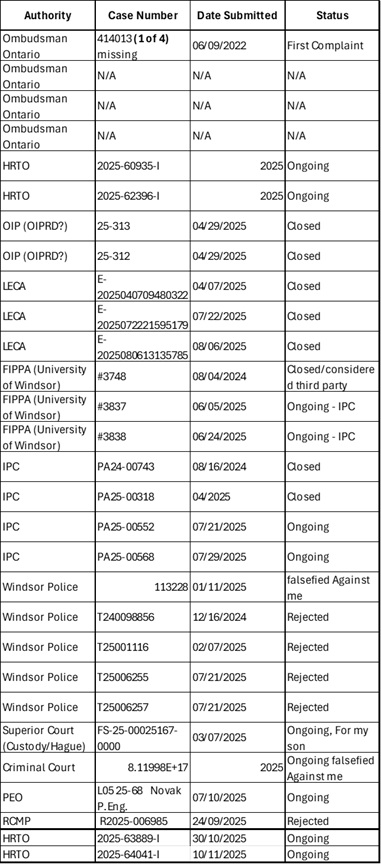
This is a complete list of filed claims.
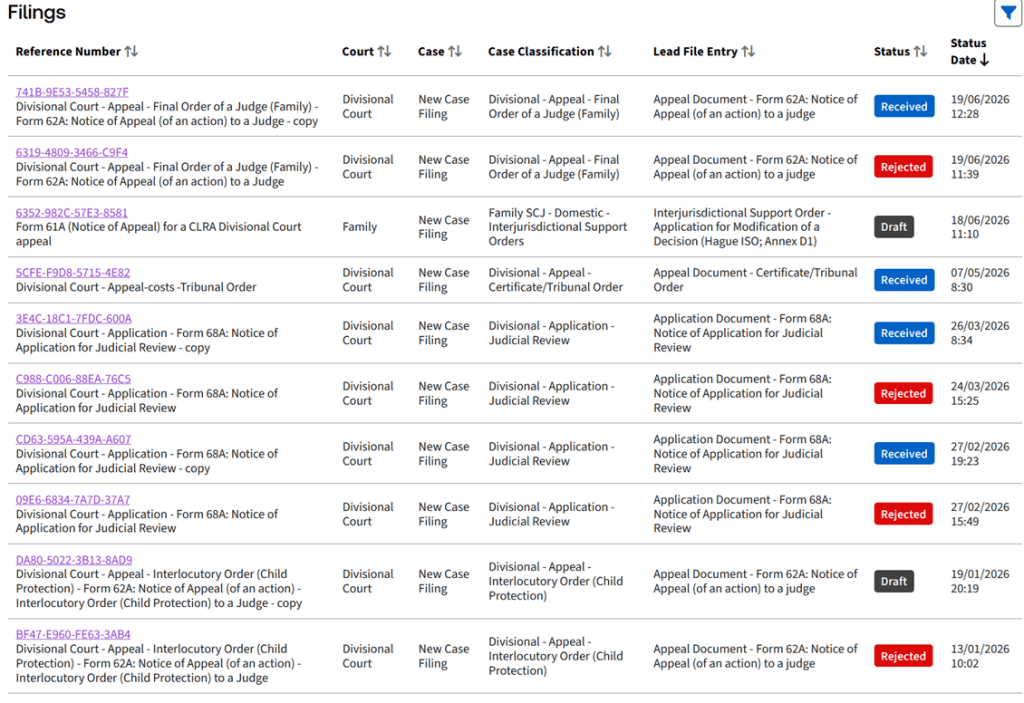
Persistently ignoring my filings for judicial review.
CLICK —> Comprehensive List of Breached Laws
Brazilian Laws Breached
Law/Statute
Breach Description
Law No. 12,318/2010 (Parental Alienation Law)
Misused to penalize protective actions against abuse; in your case, Noemi’s alienation of Isaac (e.g., denying contact) constitutes interference in psychological development, punishable by custody changes or fines, yet not enforced despite evidence. UN Special Rapporteur calls for repeal as it weaponizes claims against mothers reporting abuse.
Law No. 13,431/2017 (Specialized Hearing Law)
References to parental alienation undermine child abuse reports; breaches child protection by ignoring Isaac’s harm from separation and potential exposure to unstable environment.
Brazilian Penal Code (Decree-Law No. 2,848/1940), Article 339 (False Denunciation)
False assault claim by Noemi led to your arrest without evidence; this constitutes false reporting to authorities, punishable by 2-8 years imprisonment.
Brazilian Civil Code (Law No. 10,406/2002), Article 1,631 (Custody Rights)
Violated by Noemi’s retention of Isaac, denying joint custody and causing alienation; in Brazil, alienation can lead to custody reversal.
Brazilian Penal Code, Article 240 (Child Endangerment)
Exposing Isaac to harm through alienation and unstable immigration status; punishable by detention or fines.
Canadian Laws Breached
Law/Statute
Breach Description
Community Safety and Policing Act, 2019 (CSPA), s. 153 (Misconduct)
WPS officers failed to investigate assault/breach reports (e.g., March 3/27, 2025), dismissed fraud as “civil matters,” and imposed barriers based on your location; IOP dismissal (25-312) without review breaches mandate for compliance oversight.
Criminal Code of Canada, s. 139 (Obstruction of Justice)
WPS and University obstructed investigations (e.g., no call recordings accessed in LECA E-202508061313578590); false claims by Noemi led to your arrest without probing evidence.
Criminal Code, s. 131-132 (Perjury/False Statements)
Noemi’s unsubstantiated assault claim (WPS 113228) constitutes false statements to authorities, punishable by up to 14 years.
Criminal Code, s. 140 (Public Mischief)
Fabricated claims diverted police resources; Noemi’s actions caused wrongful prosecution.
Ontario Human Rights Code, s. 1 (Services)
Discrimination in police/university services based on origin/citizenship (e.g., location barriers, retaliation against immigrant complainant).
Canadian Charter of Rights and Freedoms, s. 7 (Life, Liberty, Security)
Wrongful arrest and prolonged alienation violated due process; delays in custody case (FS-25-00025167-0000) caused harm without justification.
Charter, s. 15 (Equality)
Discriminatory treatment as immigrant (e.g., denied Legal Aid, police inaction).
Immigration and Refugee Protection Act (IRPA), s. 41 (Overstay)
Noemi’s illegal presence post-visa expiry (Jan 30, 2025); University employing her breaches s. 124 (employing undocumented).
Children’s Law Reform Act, s. 24 (Best Interests)
Court ignored alienation harm to Isaac, denying psychiatric evaluation; breaches child welfare priorities.
Family Law Act, s. 28 (Custody)
Failure to enforce contact provision in restraining order.
International Laws Breached
Law/Statute
Breach Description
Hague Convention on Child Abduction (1980), Article 13(b) (Grave Risk)
Wrongful retention of Isaac; failure to recognize abuse/alienation as “grave risk” or “intolerable situation,” ignoring Noemi’s false claims and instability.
Hague Convention, Article 12 (Prompt Return)
Delays in custody case exceed 6-week timeline; breaches obligation for swift resolution.
UN Convention on the Rights of the Child (CRC), Article 9 (Separation)
Unjustified separation from father; alienation violates family unity.
CRC, Article 19 (Protection from Abuse)
Exposing Isaac to emotional harm through alienation; no protection from unstable environment.
CRC, Article 12 (Child’s Voice)
Court ignored Isaac’s potential harm; no evaluation despite requests.
UN Convention on Elimination of Discrimination Against Women (CEDAW), Article 16 (Family Relations)
Gender bias in misuse of alienation claims against mothers reporting abuse.
UN Convention against Corruption, Article 25 (Obstruction)
Potential deceit/false evidence in claims, obstructing justice.
This list is based on case facts and research; actual breaches require legal determination. For escalation, consider judicial review (Divisional Court) or complaints to UN bodies (e.g., CRC Committee).
This is not the end.
It is the beginning of accountability.
 Stop University of Windsor